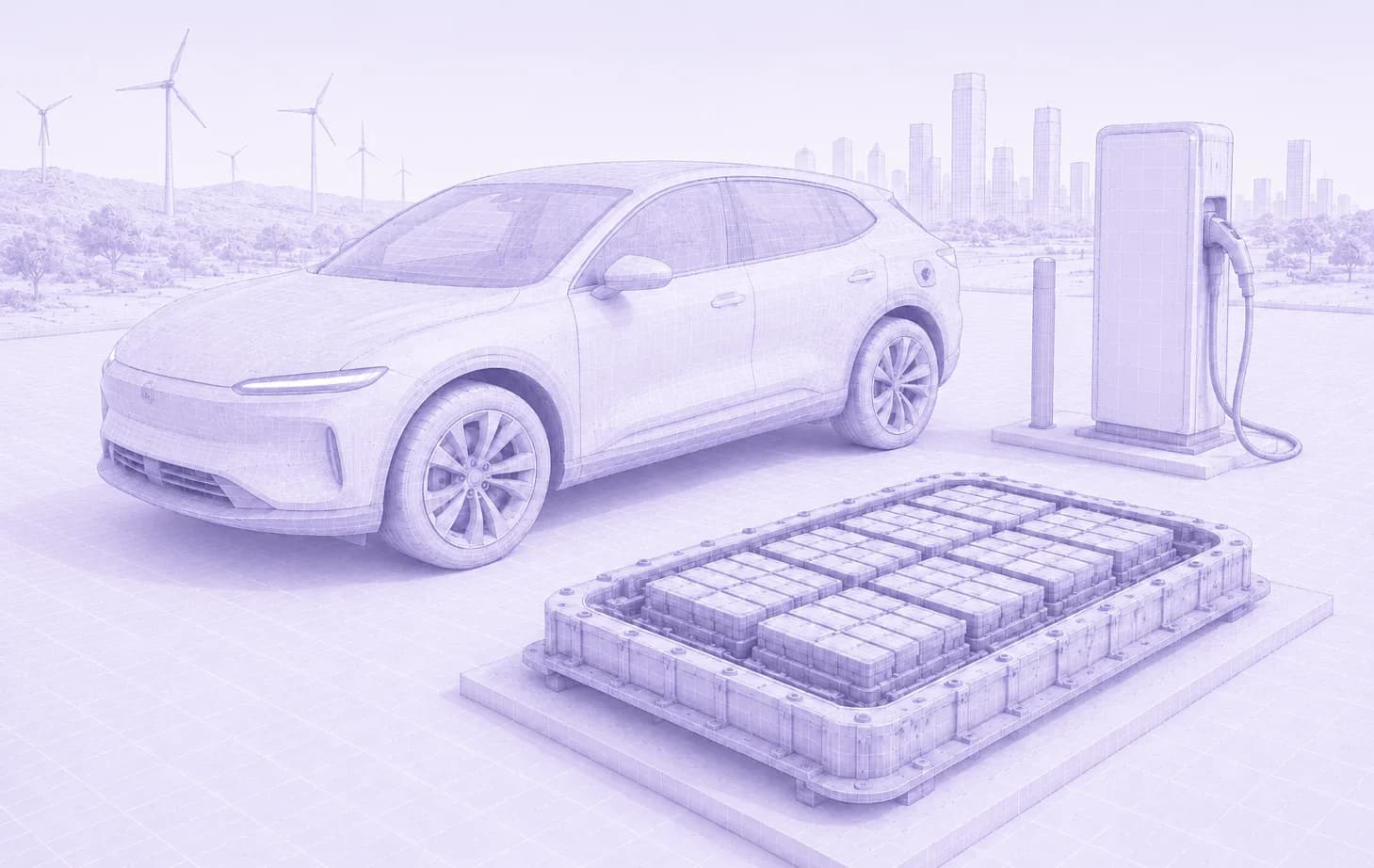
Does your EV battery need a passport?
Yes. An EV battery is any battery designed to power the propulsion of hybrid and electric road vehicles - passenger cars, vans, buses and trucks. It is one of three categories under Article 77 that Regulation (EU) 2023/1542 requires to carry a Digital Battery Passport, alongside LMT batteries and industrial batteries above 2 kWh. Unlike the industrial category, there is no capacity threshold. Every EV traction battery is in scope, regardless of its kWh rating.
That covers full battery-electric and plug-in hybrid vehicles across the passenger and commercial fleet. It applies whether the battery is supplied to the vehicle manufacturer as a finished pack, assembled from cells and modules bought separately, or fitted as a replacement pack after the vehicle is already in service.
The obligation is not retroactive. A vehicle already placed on the market or put into service before 18 February 2027 does not need its battery retrofitted with a passport. But a replacement traction pack sold after that date counts as newly placed on the market. It needs its own passport, even if it goes into an older vehicle.
EV vs LMT: where the line is drawn
The regulation defines an LMT battery as sealed, weighing 25 kg or less, and designed to power wheeled vehicles that combine an electric motor with human power, or motor power alone. It explicitly states that this is not an EV battery. An EV battery is defined by function rather than weight. For category M, N and O vehicles - cars, vans, buses and trucks - there is no weight limit at all. For category L vehicles the boundary is explicit: a battery over 25 kg powering an L-category vehicle counts as an EV battery, while one at or under 25 kg is LMT.
In practice, the boundary sits at the edge of the light-vehicle market. A pedal-assist e-bike or e-scooter pack is squarely LMT. A passenger car, van, bus or truck traction battery is squarely EV. The harder cases are heavier L-category vehicles, such as certain quadricycles, mopeds and light three- and four-wheelers. For these, check the battery's weight and the vehicle's type approval against the LMT definition before assuming which category, and which deadlines, apply.
If you build or supply batteries for e-bikes, e-scooters or similar light vehicles rather than full-sized road vehicles, our e-bike and e-scooter battery passport guide covers the LMT category and its 25 kg rule in detail.
Who is responsible: OEM, pack supplier or cell manufacturer?
The passport obligation falls on the economic operator placing the finished battery on the EU market or putting it into service. This is generally whoever sells a battery capable of performing its intended function and operating safely. In the automotive supply chain, that is most often the vehicle manufacturer, since the traction battery is placed on the market as part of the finished vehicle.
It is less straightforward where cells, modules and packs cross several company boundaries before reaching the vehicle. A cell manufacturer selling to a pack assembler, who in turn supplies a vehicle OEM, is not usually the party placing the finished battery on the market. But each upstream supplier holds data the responsible party needs to complete the passport record, such as chemistry, manufacturing carbon footprint and critical raw material origin. Contracts need to specify not just who owes the obligation, but who supplies which data field, and by when.
Replacement and aftermarket packs shift the picture again. Whoever places a standalone replacement traction battery on the market carries the obligation for that unit, separately from the vehicle it goes into. This may be the original vehicle OEM, an independent remanufacturer, or a battery specialist.
Whichever party carries that obligation, a battery passport software keeps the ownership record and supporting data straight as packs change hands between OEM, remanufacturer and specialist.
What an EV battery passport must contain
The passport groups data into five areas. These are identification (a unique identifier linking the physical battery to its record, plus model and manufacturer details), material composition (including critical raw materials and recycled content), the verified carbon footprint of production, performance and durability parameters, and end-of-life information for repair, repurposing and recycling.
For EV batteries specifically, performance and durability data carries particular commercial weight. State of health, remaining capacity and charging behaviour feed directly into vehicle warranty terms and used-vehicle valuations. Eventually, they also feed into second-life repurposing decisions once the battery leaves automotive use.
The exact mandated field list comes from Annex XIII and the implementing acts. The full breakdown by data category is in our EU battery passport data points guide.
State of health, warranty and second-life repurposing
EV traction batteries are built for a defined automotive service life. Their state of health is tracked from day one, through the vehicle's own battery management system and, increasingly, through the passport record itself. That data underpins warranty claims, informs used-vehicle pricing, and gives fleet operators a basis for deciding when a pack still has useful automotive life left.
A battery's capacity often fades below what a vehicle needs, while still well above what a stationary application requires. When that happens, repurposing into energy storage is the most common second life. The regulation treats this as a defined operation. Taking a battery from EV use into a new application, such as stationary storage, generally triggers a new passport. It is created by the party placing the repurposed battery on the market and linked back to the original record, so the battery's full history carries across.
Manufacturers and integrators building second-life storage from retired EV packs should read this alongside our BESS battery passport guide, which covers the passport obligations on the receiving side of that transition.
Key dates for EV manufacturers and suppliers
These are the milestones that matter specifically for EV batteries. The full cross-category schedule is in our EU battery passport timeline.
Regulation applies
Regulation (EU) 2023/1542 starts applying to batteries placed on the EU market, replacing the old Battery Directive 2006/66/EC framework in stages.
Carbon footprint declaration for EV batteries
EV batteries had the earliest carbon footprint declaration deadline of any battery category, effective from this date. That is a full year ahead of industrial batteries above 2 kWh, which follow from 18 February 2026. Declarations are made per battery model and manufacturing plant.
Battery passport mandatory
Every EV battery placed on the EU market or put into service needs a QR-accessible battery passport under Article 77. The QR code itself is required under Article 13(6).
Supply chain due diligence
Due diligence obligations under Articles 48-50 apply, following the two-year postponement under Omnibus IV. These sit alongside the passport rather than inside it.
Recycled content disclosure
Disclosure of recycled cobalt, lead, lithium and nickel content begins from this date, or 24 months after the relevant delegated act enters into force if that is later. This is ahead of the binding minimum targets that follow from 18 August 2031.
How EV manufacturers and suppliers can prepare
Confirm scope across your product range. Check each battery line against the EV and LMT definitions. Pay particular attention to L-category and light commercial vehicles, where the boundary is not obvious.
Map responsibility across the supply chain. For every battery line, identify who places the finished battery on the EU market: vehicle OEM, pack assembler or battery specialist. Get that agreed in writing before February 2027.
Check your carbon footprint data is already flowing. The EV carbon footprint declaration obligation has been in effect since February 2025. Confirm manufacturing-site and cell-level data is reaching whoever is responsible for the declaration.
Plan for second-life data continuity. Decide how state of health data will be captured and handed over when a pack is repurposed. This lets the second-life passport link back to the original record.
Choose how you will generate and host the passports. Each battery needs a unique identifier, a QR code and a hosted passport record with public and restricted access levels. Building this in-house is possible. Most manufacturers will use a platform instead.
EV battery passport FAQ
Does every EV battery need a passport, or only above a certain capacity?
Every EV battery, regardless of capacity. Unlike industrial batteries, which only need a passport above 2 kWh, the EV category carries no capacity threshold. The passport obligation applies to the traction battery in any hybrid or electric road vehicle placed on the EU market or put into service from 18 February 2027.
What's the difference between an EV battery and an LMT battery?
Weight and vehicle type. LMT batteries are capped at 25 kg and power wheeled vehicles such as e-bikes and e-scooters. The regulation explicitly excludes EV batteries from that definition. EV batteries have no weight limit and are defined by function: providing traction for hybrid and electric road vehicles such as cars, vans, buses and trucks.
We supply cells to a pack assembler who supplies a vehicle OEM. Do we owe the passport?
Not usually. The obligation generally falls on whoever places the finished battery on the EU market, which in a multi-tier supply chain is typically the vehicle OEM. But your chemistry, carbon footprint and material origin data still needs to reach whoever does owe it. That should be settled in your supply contracts.
What happens to the passport when an EV battery is repurposed into energy storage?
Repurposing generally triggers a new passport. The party placing the repurposed battery on the market as a stationary storage unit creates the new record. It links back to the original EV passport, so the battery's full history, including its automotive state of health, carries across.
Has the EV carbon footprint declaration deadline already passed?
Yes. EV batteries had the earliest carbon footprint declaration deadline of any category, from 18 February 2025. That is a full year ahead of industrial batteries above 2 kWh. If manufacturing-site and cell-level data isn't already flowing to whoever is responsible for the declaration, that is a gap worth closing before the broader February 2027 passport deadline.
Is a hybrid vehicle battery treated the same as a fully electric one?
Yes. The EV battery definition covers batteries that provide traction for hybrid vehicles as well as fully electric ones. The regulation does not distinguish between the two for passport purposes.
A note on pending implementing acts
The technical specifications behind the passport, such as the semantic data model, registry rules and data carrier standards, are being finalised through implementing and delegated acts. The obligations described here come from Regulation (EU) 2023/1542 itself. Configuration-level details should be confirmed against the acts as they are adopted.