What are the EU Battery Passport requirements?
Under Article 77 of Regulation (EU) 2023/1542, every in-scope battery placed on the EU market must carry a digital battery passport - a structured data record accessible via a QR code on the physical battery. The passport is not a document or a label. It is a live digital record linked to a unique product identifier, containing verified data about the battery's origin, composition, performance, and lifecycle. If the concept itself is new to you, start with Battery Passports, Explained.
The Battery Passport must include key information to ensure traceability and performance transparency:
- A unique product identifier for access to the battery passport, provided via a QR code printed or engraved on the physical battery
- Basic specifications, including battery type and model
- Lifecycle data on performance and durability, updated by parties handling repair or repurposing
- The carbon footprint specific to the manufacturing site and battery batch
- Technical documentation on electrochemical performance and durability, including methods used to collect the data
Key data points
The exact set of mandatory data fields is defined under Article 77 and associated delegated acts. Fields span material composition, carbon footprint, recycled content, state of health, and end-of-life handling. Not all fields are public - the regulation defines public, restricted, and authorised access levels. Supply chain due diligence is a separate obligation governed by Articles 48-50, not part of the passport record itself; every non-passport obligation in the regulation is covered in our EU Battery Regulation 2023/1542 guide. The full data requirements are covered in our Battery DPP Blueprint.
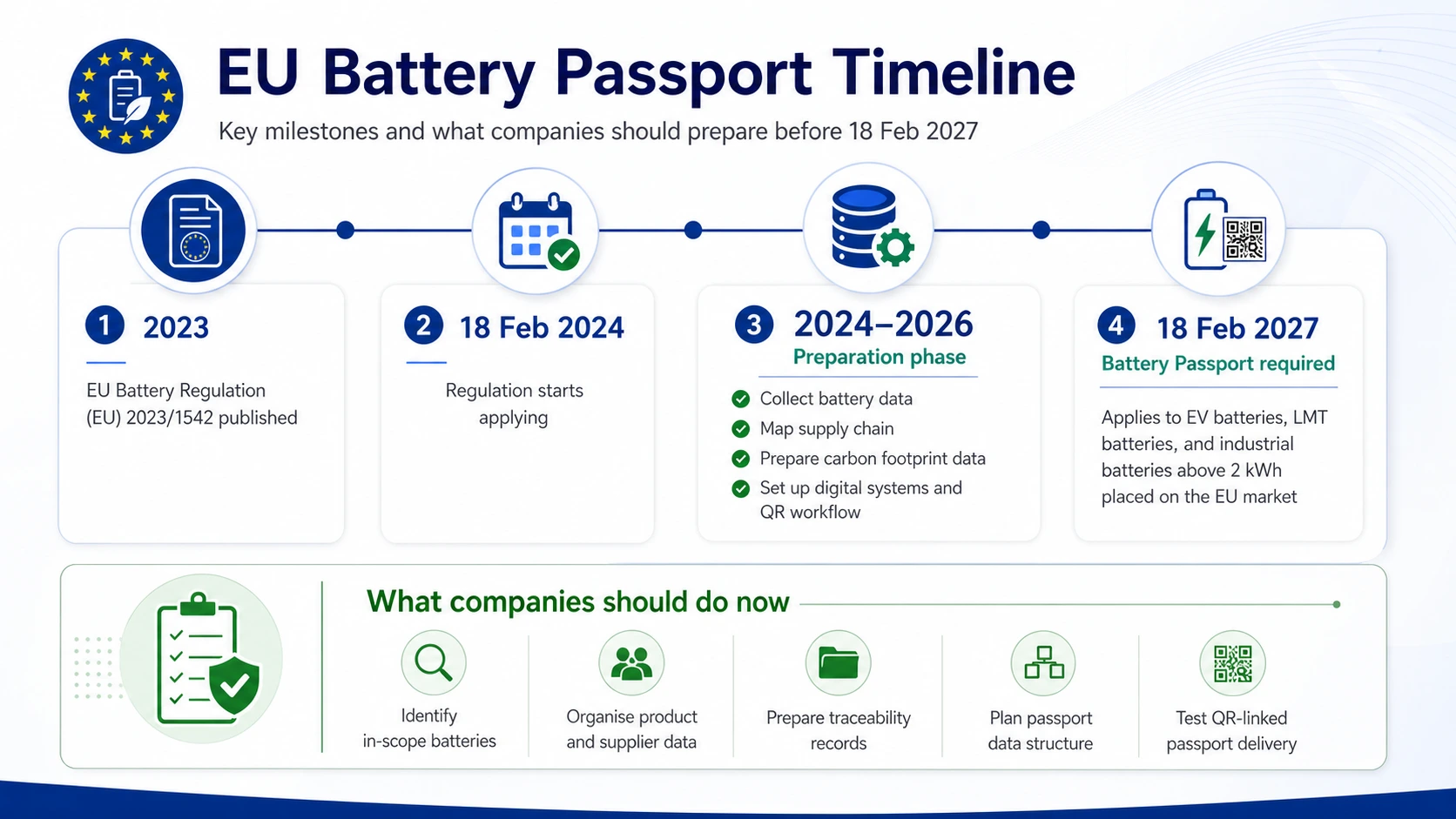
EU Battery Regulation timeline and milestones
The EU Batteries Regulation (EU) 2023/1542 came into force on 17 August 2023, introducing a phased implementation of its provisions. The regulation fully replaced and repealed the previous Battery Directive (2006/66/EC) on 18 August 2025.
Regulation published
Regulation (EU) 2023/1542 published in the Official Journal of the EU, establishing the legal framework for battery passports under Article 77.
Regulation starts applying
Several provisions formally start applying. Companies placing in-scope batteries on the EU market are subject to the regulation's requirements from this date.
Battery Directive repealed
The previous Battery Directive (2006/66/EC) is fully repealed. EU 2023/1542 is now the sole legal framework governing batteries on the EU market.
Guidelines deadline extended
The deadline for publishing implementation guidelines has been extended by one year to 26 July 2026. By 18 August 2026, the Commission must adopt an implementing act.
Battery Passport mandatory
A unique Battery Passport, retrievable via QR code, becomes mandatory for all in-scope batteries placed on the EU market, regardless of origin.
Supply chain due diligence applies
Due diligence obligations under Articles 48-50 - covering supply chain transparency, human rights, and environmental risk - apply from this date. These are separate from the Battery Passport (Article 77) and primarily affect larger economic operators. The obligation was postponed by two years under Omnibus IV.
Battery types covered by the 2027 deadline
From 18 February 2027, the battery passport requirement applies to a wide range of battery types placed on the EU market:
Electric Vehicle (EV) Batteries
Traction batteries for EVs
Batteries for e-bikes, e-scooters, and other light means of transport
Any industrial battery with a capacity over 2 kWh
What companies need to do now
It is Q2 2026. The February 2027 deadline is less than nine months away. Most organisations that have not started yet are already at risk. Data collection and supplier coordination - not building the passport itself - is where time gets lost. For a step-by-step roadmap, see our battery passport compliance guide for 2027.
If you have not started, the time to act is now. Circuland's battery passport platform is built specifically for this stage - structuring fragmented supplier data, calculating carbon footprint per battery model, and delivering QR-accessible passport records before the deadline. For the full regulation in one place, see our complete guide to EU battery passports, or compare vendors in our 2026 battery passport software guide.
- 1Identify in-scope battery types across your product range
- 2Map your supply chain and collect cell, module, and material data
- 3Prepare carbon footprint calculations per battery model
- 4Define your data governance and update processes
- 5Set up digital systems and QR-linked passport delivery