Battery Passports
Create, manage and publish your Battery Passports in one platform. Built for EV, LMT and industrial batteries ahead of 18 February 2027.
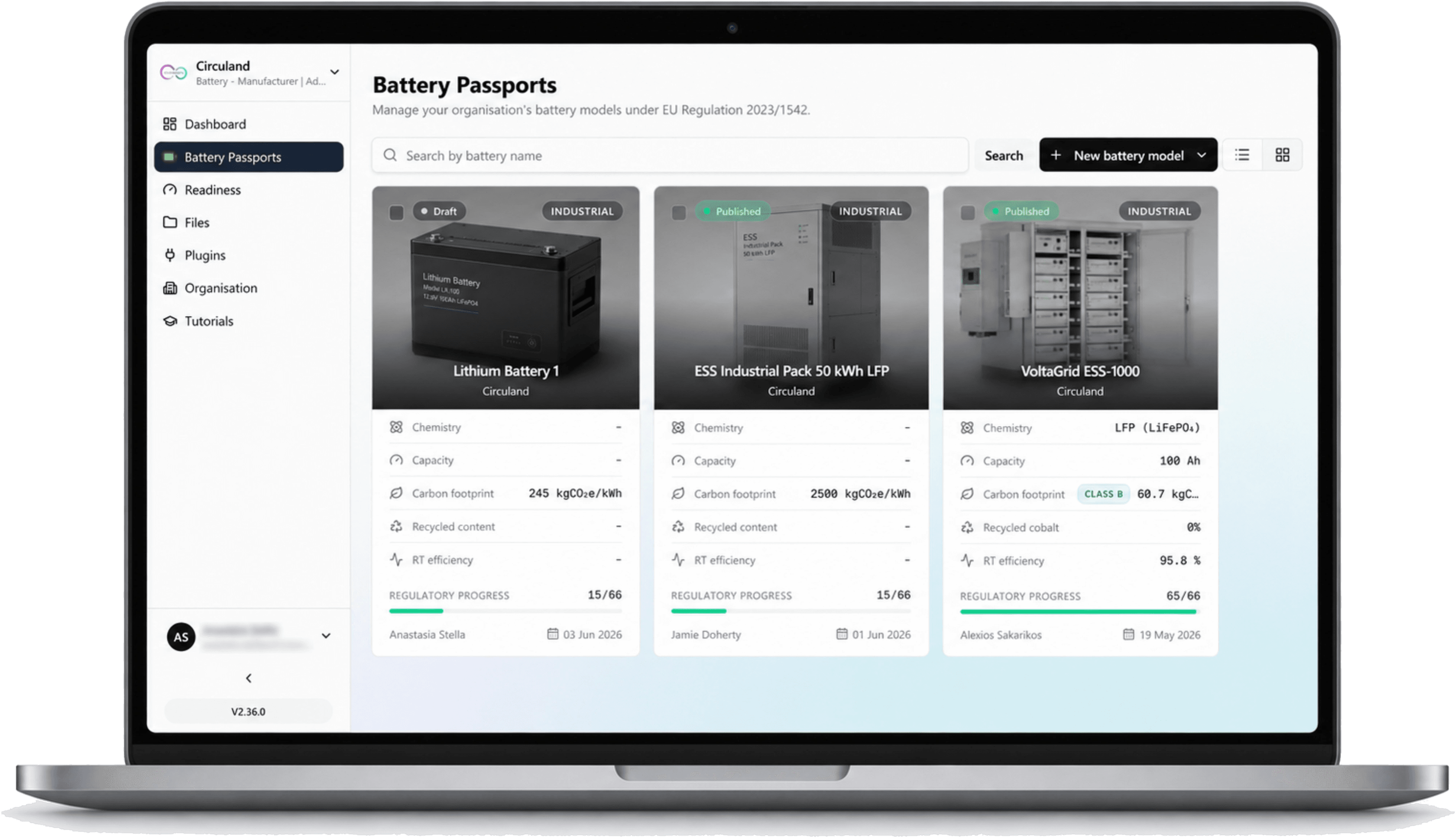
Built for both SMEs and large battery manufacturers
Whether you need managed compliance support or a platform that plugs into your existing stack, our Battery Passport solution scales with you.
See how this fits your sector on our battery industry page, covering EV, LMT and industrial batteries.
Fully managed compliance for SMEs
If you're a battery producer, pack assembler, importer or distributor without a dedicated EU Battery Regulation 2023/1542 team, we support you end to end - from data collection to Battery Passport issuance and ongoing upkeep.
- For SMEs with no in-house compliance department
- We handle supply-chain data collection, carbon footprint reporting, and QR passport issuance end-to-end
- Managed service: our team runs the platform, you stay focused on production and sales
- February 2027 ready without hiring a regulatory specialist
Built for the battery passport, not just the deadline
The detail that decides whether your QR codes still work after February 2027, and if you ever switch providers.

Identifiers
Every QR code is print-ready and standards-compliant from day one, whichever identifier fits your business.
Domain ownership
Publish passports on a web address you own, verified with a one-time DNS check. Printed codes keep working even if you change platform later.
Domain verified
Certificates renew automatically
Languages & accessibility
All 24 official EU languages and more, plus a dyslexia-friendly, high-contrast reading mode for operators and consumers alike.
Full lifecycle
A passport follows the battery, not the paperwork.
Active
In service, live data
Repurposed
History carried forward
Retired
Still public, with a notice
Open access, gated detail
Every change to a restricted field is logged.
Public
Scan and view, no login
Restricted
Regulators & approved partners only
Deployment
Runs entirely in the browser, with nothing for your team to install or maintain.
Cloud-hosted
Hosted on Microsoft Azure
Browser-based
No install, no local setup
Ask your Battery Passport anything
Our AI assistant helps analyse your supply-chain data, regulatory requirements, and compliance documents. Query battery passport readiness, carbon footprint, or conformity files in natural language.
- Instant compliance checks against EU Battery Regulation 2023/1542
- Live carbon footprint calculations with tier-2 supplier traceability
- Pulls QR passports and material composition on demand
Your Battery Compliance Assistant
How Circuland's Digital Battery Passport Platform Works
Centralise your battery data
Aggregate compliance documents, supply chain certificates, audit records, material declarations, and carbon data into one secure platform. Circuland integrates directly with your existing PIM, PLM, ERP, and BIM systems.
AI-powered passport generation
Our AI engine extracts, validates, and structures the required data fields automatically - mapping your existing documentation to the required passport data fields. No manual re-entry.
Issue and manage passports at scale
Generate unique battery identifiers and QR codes linked to each battery passport. Manage battery passports across your entire product portfolio from a single dashboard.
Stay compliant as regulations evolve
Regulation requirements will continue to evolve through 2027 and beyond. Circuland's platform is updated continuously to reflect the latest delegated acts and implementation standards.
Everything you need
Powerful features designed for modern teams
Supply Chain Traceability
Track materials from mine to cell to vehicle, with full chain-of-custody documentation across every tier.
Carbon Footprint Tracking
Calculate and declare lifecycle carbon emissions per battery model, in line with EU Regulation 2023/1542 requirements.
QR Code Identity
Issue regulation-compliant unique battery identifiers with publicly accessible passport links, per ISO/IEC 15459.
State of Health Monitoring
Support state-of-health and remaining useful life data during the operational phase.
Lifecycle Records
Store audits, certifications, recycling data, and repurposing records across the full battery life.
Regulatory Compliance Monitoring
Automated alerts and compliance scoring against EU 2023/1542 requirements and delegated acts.
The February 2027 deadline is closer than it looks
Most of the work is chasing supplier data and mapping it to the regulation's data model - that part takes months, whichever tool you pick. Start while the calendar still has slack.
Designed to support Article 77 battery passport requirements across EV, LMT, and industrial battery categories.
Map component origins, recycled content percentages and carbon footprint across every tier of your battery supply chain - the hardest part of Article 77.
Built for the full battery value chain
Covering every role in the EU Battery Regulation 2023/1542 compliance landscape.
Battery Cell Manufacturers
Issue model-level and unit-level passports directly from production. Automatically populate carbon footprint and material composition data from your existing BOM systems.
Automotive OEMs
Receive, validate, and publish battery passports for vehicles placed on the EU market. Demonstrate supply chain due diligence to regulators and consumers.
Pack Assemblers & Tier 1 Suppliers
Aggregate data from multiple cell suppliers into a single compliant passport. Manage multi-supplier battery pack complexity at scale.
Energy Storage System Operators
Manage passports for industrial batteries used in stationary storage above 2 kWh, including state of health reporting and second-life transition records.
Recyclers & Second-Life Operators
Access passport data to assess battery health, material content, and recycled content targets. Contribute updated end-of-life records back to the passport.
Why manufacturers choose Circuland for battery passports
AI-powered data extraction
Our AI engine maps your existing documents and systems onto EU Regulation 2023/1542 data fields - removing weeks of manual work from each product line.
Multi-sector DPP platform
One platform for batteries, construction, fashion, and tyres. Built to support multiple Digital Product Passport use cases as EU requirements expand.
PIM, PLM, ERP and BIM integration
Circuland plugs into your existing stack - no rip-and-replace. Open APIs and standard data connectors mean faster go-live and lower total cost.
Enterprise-ready, SME-friendly
Most battery passport platforms are enterprise-only. Circuland scales from early-stage manufacturers to Tier 1 automotive suppliers - same platform, same standards.
What is a Battery Passport?
A Battery Passport (also called a Digital Battery Passport, or DBP) is a structured digital record that stores all key data about a battery across its entire lifecycle - from raw material sourcing to end-of-life recycling. Mandated under EU Battery Regulation 2023/1542, covered EV, LMT, and industrial batteries above 2 kWh placed on the EU market will require a battery passport from 18 February 2027.
The passport is linked to the physical battery via a unique identifier - typically a QR code - and is accessible via QR code with public and restricted data layers for the public, regulators, and authorised stakeholders. It covers material composition, carbon footprint, supply chain provenance, state of health (SoH), recycled content, and end-of-life instructions.
Beyond compliance, the Battery Passport creates commercial value: better second-life asset intelligence, stronger supply chain transparency, reduced due diligence costs, and improved ESG reporting.
New to the concept? Read our plain-English guide, Battery Passports, Explained. Selling e-bikes or e-scooters? Our e-bike battery passport guide covers the LMT rules.
What a Battery Passport Contains
- Material composition
- Carbon footprint
- Supply chain origin
- State of health
- Recycled content
- Hazardous substances
- Manufacturer data
- End-of-life instructions
EU Battery Regulation 2023/1542: Key Requirements
Who must comply?
Any manufacturer, importer, or distributor placing EV batteries, LMT batteries, or industrial batteries above 2 kWh on the EU market after February 2027.
What does the regulation require?
- A unique battery identifier linked to the passport, typically accessed via QR code or data matrix
- A digital record accessible throughout the battery lifecycle
- Carbon footprint declaration per battery model
- Due diligence on cobalt, lithium, natural graphite, and nickel sourcing
- State of health and remaining useful life (for batteries in use)
- Recycled content percentage by material
- End-of-life handling and recycling instructions
Key dates
See every milestone in our EU battery passport timeline.
What goes into a Battery Passport
From 18 February 2027, every EV battery, industrial battery over 2 kWh and light-means-of-transport battery sold in the EU must carry a passport you can reach by scanning a QR code on the pack. The passport covers the battery from the mine to the recycler. Some fields are open to anyone; others sit behind role-based access for repairers, second-life operators and recyclers. Recycled-content thresholds tighten from 2031 onwards.
What the passport has to contain
Battery identity
Serial number, manufacturer, place and date of production, and the QR code that resolves to the public passport.
Materials and sourcing
What the battery is made of - lithium, cobalt, nickel, graphite and the rest - where each came from, and how much of it is recycled.
Carbon footprint
Cradle-to-gate CO2 per kWh for the specific battery model, following the PEFCR method the EU recognises.
Performance and ageing
Rated capacity, expected cycle life, and live state-of-health and state-of-charge once the battery is in use.
Safety, repair and end-of-life
Hazardous substances, dismantling and repair guidance, and what a recycler needs to process the battery at end-of-life.
For the full field-by-field data model, read our Battery DPP Blueprint.
Who sees what
- Publicly accessible fields: basic battery details, material composition and sustainability metrics - the things a buyer or a regulator might want to check.
- Restricted fields for authorities and authorised parties: dismantling procedures, exact chemical composition and other technical detail that only repairers, second-life operators and recyclers need.
Who and when
- Applies to EV batteries, light-means-of-transport (LMT) batteries and any industrial battery above 2 kWh placed on the EU market.
- Passport mandatory from 18 February 2027. Tighter recycled-content targets follow in 2031.
See the Battery Passport Platform
Create structured passport records, connect Akeneo, Pimcore, Office 365 and Revit, manage documents, and publish QR-linked Battery Passports - all in one Circuland platform.
- Guided builder for identity, chemistry, performance and lifecycle
- Plug-in connectors for PIM, document storage and BIM
- QR-linked public and restricted passport pages
- Cuts passport prep time by up to 90%
EU Battery Passport
EV Pack DBP-37A
Frequently Asked Questions
Circuland supports compliance with EU Battery Regulation 2023/1542, EU ESPR (Ecodesign for Sustainable Products Regulation), and related Digital Product Passport mandates across batteries, construction, and other regulated sectors.
It depends mainly on how many battery models and suppliers are involved, since data collection is usually the largest cost. Circuland's own software plans start free and scale with passport volume. Our battery passport cost guide breaks down every cost factor in detail.
The EU Digital Product Passport (DPP) registry is a central system run by the European Commission under Article 13 of the Ecodesign for Sustainable Products Regulation (ESPR), expected to go live on 19 July 2026. It stores the unique identifiers that connect physical products to their digital passports, so customs and market surveillance authorities can verify compliance. Batteries are governed by the separate EU Battery Regulation, but manufacturers will still register their unique identifiers here - the passport's underlying data stays with the manufacturer or its provider, while the registry confirms that a passport exists and that the product may be placed on the EU market.
Circuland brings product data, supplier evidence, documents, and unique identifiers into one platform, then helps teams assemble each Battery Passport, set access tiers, and publish it to a QR-linked record. A readiness tracker shows what is complete and what is still missing, so you can see how close each battery is to compliance.
Circuland is built specifically for regulated Digital Product Passports, with AI-assisted data collection, supplier workflows, and connectors to the systems manufacturers already use. It is designed to take teams from scattered supplier files to a compliant, QR-accessible Battery Passport without rebuilding their existing data stack.
Get your battery passport programme started today
Battery manufacturers and automotive OEMs have 12-18 months of data infrastructure work between first workshop and a compliant passport going live. We'd rather walk you through it in a 30-minute call than watch you start this in December 2026.
Get Started FreeBook a DemoGet ready for 18 February 2027
Explore how Circuland helps you meet the EU Battery Passport mandate end-to-end.