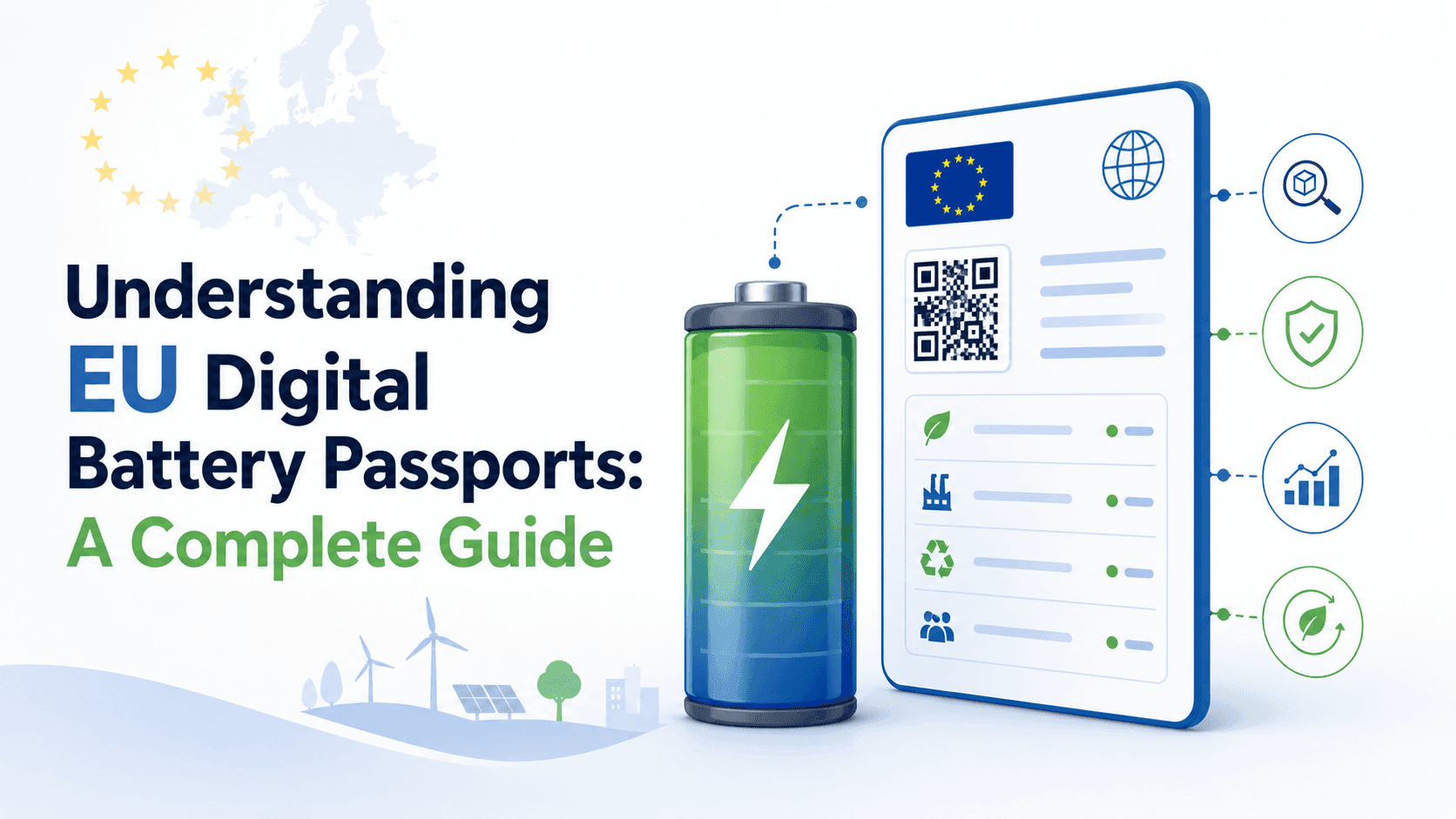
As of September 2026, the February 2027 deadline for the EU Digital Battery Passport is no longer on the horizon,it is an immediate operational priority. Mandated by the EU Battery Regulation, this passport is the first of many Digital Product Passports (DPPs) poised to reshape European industry under the Ecodesign for Sustainable Products Regulation (ESPR). For battery manufacturers, EV producers, and industrial operators, the time for strategic implementation is now.
This guide provides an actionable breakdown of what the battery passport requires, who is liable, and how your organisation can transform this complex regulatory mandate into a tangible competitive advantage.
What is a Digital Battery Passport?
A Digital Battery Passport is a comprehensive electronic record that chronicles a battery's entire journey, from the sourcing of its raw materials to its end-of-life recycling and reuse. Each passport is unique to a single battery and will be accessible via a QR code printed on the unit.
Which Batteries Require a Passport?
The regulation applies to specific battery categories placed on the market or put into service within the EU. If your business manufactures, imports, or integrates the following batteries, you must comply from February 2027
Electric vehicle (EV) batteries: Batteries designed to provide traction power for hybrid or electric vehicles.
Light means of transport (LMT) batteries: Batteries used in vehicles like e-bikes and e-scooters.
Industrial batteries with a capacity above 2 kWh: A broad category that includes stationary energy storage systems used for industrial activities, grid support, or powering communication infrastructure.
Portable batteries and conventional SLI (starting, lighting, ignition) batteries are currently exempt from the passport requirement.
Who is Responsible for the Battery Passport?
The EU Battery Regulation places full legal responsibility on the "economic operator" who first introduces the battery to the EU market. This is typically the battery manufacturer or the importer bringing batteries in from a third country
Core Responsibilities:
Issuing the initial Digital Battery Passport for each battery.
Ensuring the accuracy and completeness of all data points.
Continuously updating the passport with dynamic data throughout the battery's lifecycle.
Maintaining the secure data infrastructure that underpins the passport.
Implementation Risk: Inherited Liability
The liability for an inaccurate or incomplete passport rests entirely with the economic operator. This creates a critical risk: any data gaps or errors from your upstream suppliers become your direct legal and financial problem. A robust data governance strategy is not optional; it is an essential risk mitigation tool.
What Information is Required and Who Can Access It?
The passport must contain between 80 and 90 data points that cover the battery's full lifecycle. This information is organised into seven key areas:
General Information: Manufacturer details, battery model, manufacturing date, and location.
Compliance and Certification: EU declaration of conformity, test reports, and safety symbols.
Carbon Footprint: The total carbon emissions generated across the battery's lifecycle.
Supply Chain Due Diligence: Evidence of responsible sourcing for raw materials like cobalt, lithium, and nickel.
Materials and Composition: Details on battery chemistry and the presence of critical or hazardous raw materials.
Circularity and Resource Efficiency: Data on recycled content, repairability, and detailed dismantling instructions.
Performance and Durability: Information on rated capacity, state of health, temperature ranges, and expected lifetime.
Data is classified as either static (e.g., manufacturer name, battery chemistry) or dynamic (e.g., state of health, charge cycles), with dynamic data requiring updates during the battery's operational life. Access is tiered, with different information available to the general public, authorised bodies like auditors, and economic operators with a "legitimate interest," such as repairers or recyclers.
How is the Battery Carbon Footprint Calculated?
You are required to declare a carbon footprint value covering four lifecycle stages: raw material acquisition, manufacturing, distribution, and end-of-life. Crucially, the methodology mandates the use of company-specific primary data for the manufacturing and distribution stages, according to the EU Commission Draft Delegated Act.
Implementation Risk: Supply Chain Data Collection
Collecting verified primary activity data from a multi-tiered global supply chain is a monumental task. It necessitates deep collaboration and a trusted, auditable system for data exchange. Relying on industry averages (secondary data) where primary data is mandated will result in immediate non-compliance and potential market access denial.
What Are the Supply Chain Due Diligence Requirements?
The regulation requires your battery passport to link to a public report detailing your company's supply chain due diligence policies. This report must demonstrate alignment with international frameworks like the OECD Due Diligence Guidance and prove you are actively identifying and mitigating social and environmental risks in your mineral supply chains.
Implementation Risk: Traceability Blind Spots
Tracing materials like cobalt, lithium, and natural graphite back to their point of origin and verifying compliance claims is notoriously complex. Modern platforms can dramatically reduce this burden. For example, Circuland's AI agents can automate the process of requesting, ingesting, and verifying documentation from hundreds of suppliers, flagging risks in real-time so your team can focus on exceptions.
What is the Business Value of the Battery Passport?
While compliance is the immediate driver, the battery passport is also a gateway to significant commercial value. By breaking down information silos, it unlocks:
New Revenue Streams: Verifiable state-of-health data creates trusted secondary markets, enabling second-life applications for used EV batteries in stationary energy storage.
Improved Product Performance: Lifecycle data provides invaluable R&D insights for designing more durable, efficient, and profitable future products.
Reduced Operational Costs: Detailed dismantling and recycling information helps optimise end-of-life processes, increasing the recovery rate of valuable materials.
Enhanced Brand Equity: Transparently sharing verified carbon footprint and due diligence data builds trust with customers, investors, and regulators.
The passport transforms a regulatory burden into a strategic asset for building a more circular and resilient business.
How to Choose a Battery Passport Provider
With the 2027 deadline less than a year away, building a compliant system in-house is a high-risk, high-cost distraction. The market for battery passport software for manufacturers EU regulation is maturing quickly. As you compare battery passport platforms in Europe, prioritise a provider whose software can:
Integrate Seamlessly: The platform must connect with your existing ERP, PLM, MES, and other systems to avoid creating new data silos and ensure a single source of truth.
Automate Supply Chain Data Collection: The system should make it easy for your suppliers to submit data and automate the process of collection, validation, and aggregation across multiple tiers.
Manage Granular Access Rights: The platform must be able to securely manage tiered access rights, ensuring different stakeholders see only the data they are permitted to view.
Provide Advanced Analytics: Look for a solution that goes beyond basic data storage to provide robust carbon calculation, lifecycle analytics, and reporting dashboards.
Guarantee Ongoing Compliance: The provider should act as a partner, actively monitoring regulatory changes and updating the platform to ensure your passports remain compliant.
A comprehensive platform is more than just software companies use for battery passports; it is a strategic partner for navigating the new data-driven, circular economy.
Navigating the Future: Remaining Uncertainties
The EU Battery Regulation is a framework, not a final, static document. The European Commission is still finalising critical details through more than 50 "Delegated and Implementing Acts." These acts will specify the exact methodologies for calculating recycled content, define performance and durability thresholds, and further clarify data access rights for second-life operators.
Implementation Risk: Regulatory Evolution
This evolving regulatory landscape represents a significant risk for any rigid, in-house compliance solution. The most effective way to de-risk your strategy is to partner with a dedicated platform provider that commits to monitoring and adapting to these legislative updates. This ensures your passports remain compliant without requiring constant re-engineering from your internal teams.
The EU Digital Battery Passport marks a fundamental shift in how products are designed, manufactured, used, and valued. While the challenges are significant, the opportunities for innovation, efficiency, and market leadership are immense.
To see how you can streamline compliance and unlock the commercial value of your products, explore Circuland's AI-powered Digital Product Passport platform or visit our Resources & Insights hub for more expert analysis.