EU Battery Passports: What Operators Must Do by Feb 2027
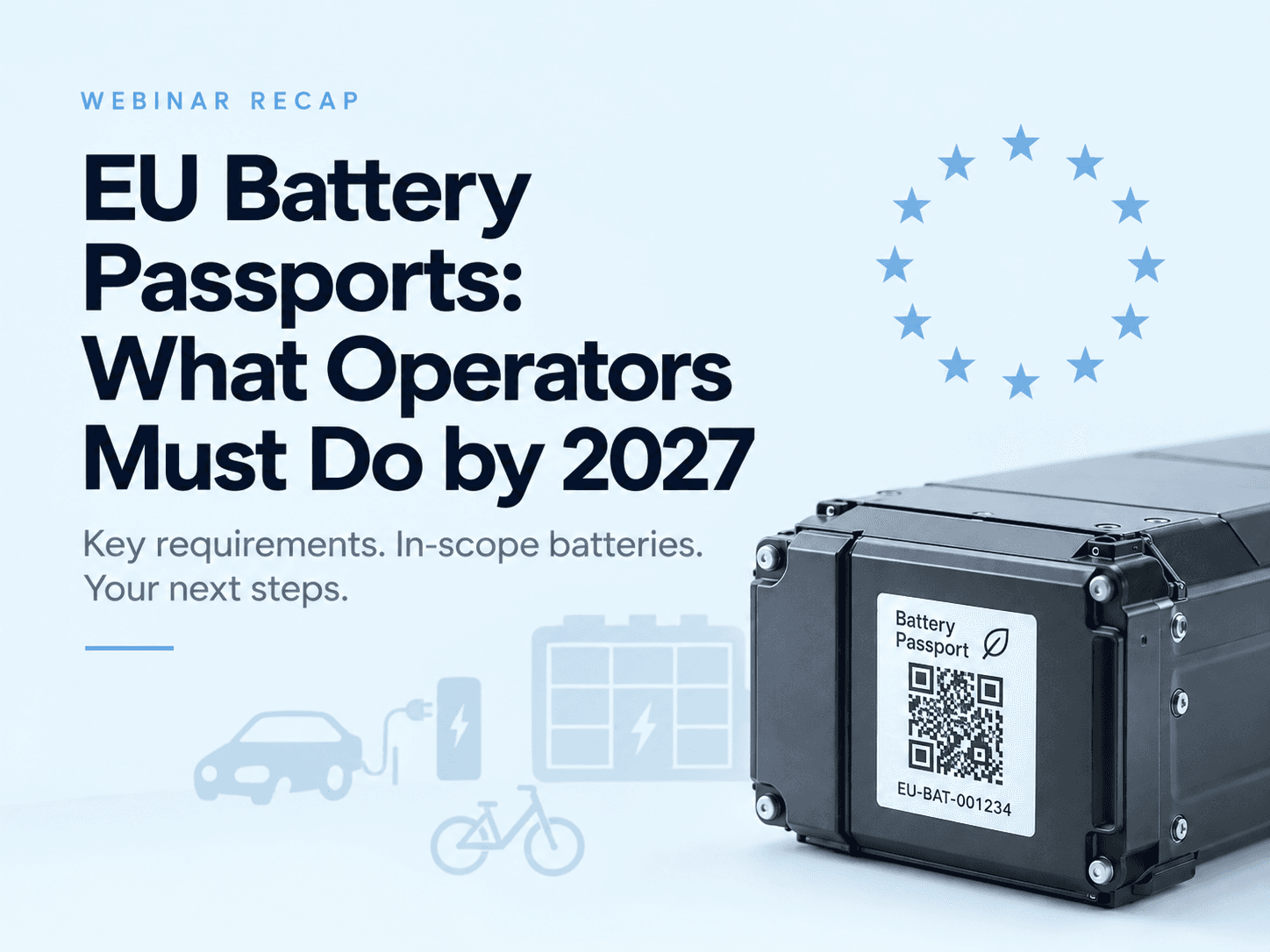
A recap of the members-only webinar hosted by the Energy Storage Association (ESA UK), where Circuland co-founder and CTO Angelo Mermiklis walked members through the EU Battery Regulation, Article 77, and what economic operators need in place before 18 February 2027.
This article summarises the session: how the old directive became a binding regulation, which batteries are in scope, who holds the compliance obligation, and the practical steps ESA members were given to get ready in time.
Prefer a step-by-step guide instead of a recap? Read our EU Battery Passport Compliance 2027 guide or see every milestone on the battery passport timeline.
Battery passport requirement starts for in-scope batteries.
Regulation (EU) 2023/1542, binding directly in every member state.
SLI and portable batteries need a QR code and label, not a full passport.
Leaves time to fix issues before the slow December/January period.
From directive to regulation
A directive could be applied differently by each EU member state. Regulation (EU) 2023/1542 changes that: under Article 96 it is binding in its entirety and directly applicable across the whole EU, with no national opt-out and no transposition delay. It entered into force in August 2023, applied generally from 8 February 2024, and the old directive was repealed in August 2025.
Directive 2006/66/EC (repealed August 2025)
- Covered portable, industrial and automotive batteries
- Paper labels, no digital record requirement
- Focused on end-of-life and recycling efficiency
- Implemented differently by each member state
Regulation (EU) 2023/1542 (in force)
- One law, directly applicable in every EU member state
- Introduces the digital battery passport and QR-style data carrier
- Covers whole-life carbon assessment, not just end-of-life
- Sets tougher material recovery and recycling targets
Which batteries need a passport under Article 77
Three categories need a full battery passport from 18 February 2027. SLI and portable batteries still need a data carrier, but with lighter requirements. If this is new territory, our Battery Passports, Explained guide covers the basics first.
Light means of transport (LMT)
Batteries in e-bikes, scooters and mopeds. Full battery passport required.
Electric vehicle (EV) batteries
Traction batteries that power the vehicle, not the separate SLI starter battery. Full battery passport required.
Industrial batteries over 2 kWh
Stationary storage, motive and other industrial applications above the 2 kWh threshold. Full battery passport required.
SLI & portable batteries
Starter/lighting/ignition and everyday portable batteries (e.g. AAA) need a QR code linking to labelling and conformity data, but not a full passport.
Who holds the obligation
Article 77 puts the obligation on the economic operator placing the battery on the EU market, though it may give written authorisation to another operator to act on its behalf. “Economic operator” covers several roles across the supply chain.
Manufacturer
Makes the battery and sells it under its own name or trademark.
Authorised representative
EU-based entity holding a written mandate for a manufacturer based outside the EU.
Importer
Brings batteries into the EU market from outside it, including into the UK-to-EU supply chain.
Distributor
Places EU-sourced batteries into the market without importing or manufacturing them.
Fulfilment service provider
Handles storage, packing or dispatch of batteries into the EU market on behalf of another party.
Article 44 matters here: an importer or distributor becomes the manufacturer if it sells the battery under its own brand, or modifies it. Buy batteries and place them into the EU market under your own name, whether as a standalone product or built into something else, and you become the economic operator responsible for that battery’s passport, regardless of which EU member state it ends up in.
An instance-level record with three access tiers
The battery passport sits at the instance level: two batteries of the same model share model-level data (chemistry, carbon footprint, performance, dismantling), but each one gets its own unique passport that tracks its own state of health, state of charge, negative events and lifecycle path.
Because supply chains involve commercially sensitive information, the regulation splits passport data into three access tiers.
Identity and label data, chemistry, carbon footprint, performance and durability. Visible to anyone who scans the passport, including end consumers making a purchase decision.
Detailed composition, dismantling and safety information, and state of health or status. Available to repairers, manufacturers, recyclers and purchasers handling the battery’s second life.
Test reports and compliance evidence, for notified bodies, market surveillance authorities and the European Commission.
Three paths to compliance
Whichever route you take still has to meet the same technical requirements: a QR, NFC or RFID data carrier built to the JTC 24 standard, a unique identifier per battery, and data that is open, machine-readable and free of vendor lock-in. A purpose-built battery passport platform is what most of the room said they were leaning towards.
Build in-house
~1 to 1.5 yearsFull control of the data model; fits your existing PLM/ERP; licence spend is closer to capex.
Watch out: You still have to build to the JTC 24 standard yourself (quiet zone, cut corner, human-readable identifier) and keep maintaining it as the regulation and standards evolve.
Integrate via API
Depends on existing systemsReuses ERP, PLM or PIM data you already hold; status updates can be automated once connected.
Watch out: These systems were not built for battery passport compliance, so data mapping and BMS data feeds need real attention.
Buy a platform
Fastest to launchThe data model and JTC 24 standards work is already solved; what is left is collecting and entering your data.
Watch out: Check data portability and exit terms, and print QR codes on your own domain so you can switch platforms later if you need to.
Five steps before the deadline
With the deadline five months out at the time of this session, ESA and Circuland set out the same practical checklist for members to work through.
- 1
List every battery model and confirm its Article 77 category
Is it LMT, EV traction, or industrial over 2 kWh? That determines whether a full passport is required.
- 2
Decide your route and who the authorised operator is
Build, integrate or buy, and agree which economic operator in your chain owns the obligation and where the data will be hosted.
- 3
Collect the required data
Work through the regulation’s data annexes with your suppliers, and start with the fields that are hardest to source, such as carbon footprint and detailed composition.
- 4
Generate and place your QR codes correctly
Whether through an integration or your platform of choice, the printing and placement of the digital tag still needs to follow the JTC 24 standard.
- 5
Be operationally ready well before the deadline
Aim for November 2026. December is a slow month for most teams, and January will not give you enough runway to fix problems before 18 February 2027.
From the Q&A
05 questions01What is the EU battery passport deadline?
From 18 February 2027, light means of transport (LMT) batteries, electric vehicle batteries, and industrial batteries above 2 kWh placed on the EU market must have a digital battery passport under Article 77 of Regulation (EU) 2023/1542.
02Which batteries need a full battery passport?
LMT batteries (e-bikes, scooters, mopeds), EV traction batteries, and industrial batteries over 2 kWh. SLI and portable batteries need a QR code linking to labelling and conformity information, but not a full passport.
03As an installer selling batteries to end customers, are we the distributor, or is it whoever we buy from?
It depends on where the battery comes from. If you buy it already on the EU market, the economic operator that placed it there should already have issued a battery passport. If you import a battery from outside the EU and then sell and install it, you are the one putting it into the EU market, which makes you the economic operator responsible for it.
04If I build a product like an e-bike around a battery I import, am I responsible for that battery’s passport too?
Yes. If you procure a battery from outside the EU and place it inside a product you sell into the EU market, you become the economic operator for that battery, not just for the finished product. You either need to source a battery that already has a passport, or create one for that specific instance yourself.
05Is the EU battery passport registry open yet for platforms to integrate with?
Not at the time of this session. Platform providers are waiting for the EU to open the registry APIs so that newly minted passports can be logged with it directly.
Prepare your Battery Passport data before the deadline
Circuland helps battery teams move from scattered supplier files and compliance documents to structured, governed, and updateable Digital Battery Passport records.
Thanks to the Energy Storage Association for hosting this session. ESA members can access the full recording and slide pack through the members hub.
Get ready for 18 February 2027
Explore how Circuland helps you meet the EU Battery Passport mandate end-to-end.
Digital Battery Passport software
AI-powered software covering supplier data, carbon footprint, lifecycle records and QR access for EV, LMT and industrial batteries.
See the softwareBattery Passport Platform
Create, manage and publish Battery Passports with native Akeneo, Pimcore, Office 365, SharePoint and Autodesk Revit connectors.
Explore the platform