Where AI can reduce manual work in battery passport data
Battery passport data sits in supplier PDFs, test reports, spreadsheets and emails. AI can take on the repetitive handling, while your team stays responsible for what gets published.
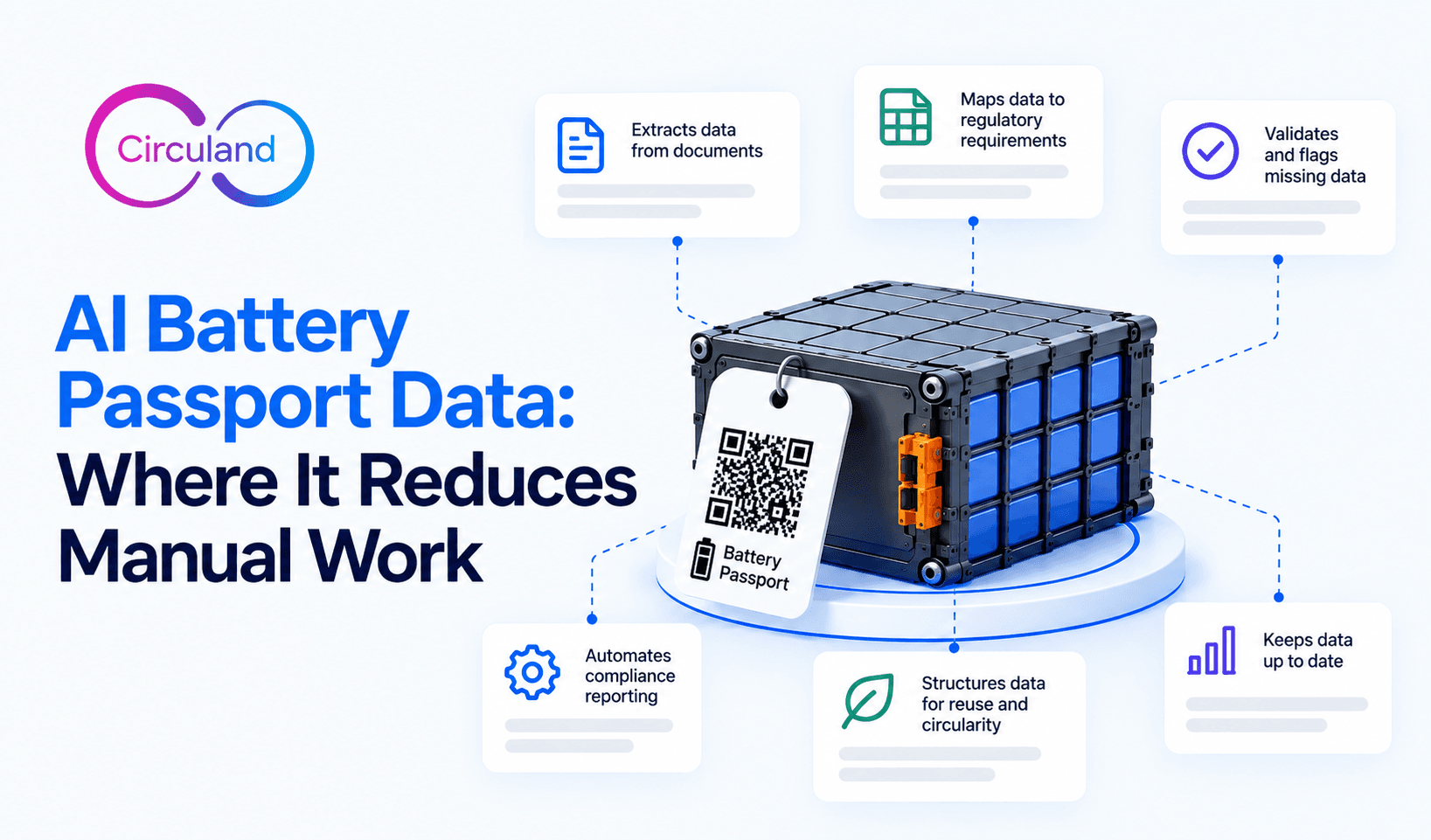
The opportunity is bigger than reading documents
Extracting text from a PDF is the easy part. The harder work is keeping data consistent across suppliers, documents, systems and product versions, and knowing at any moment what is still missing. That is where assistance saves the most time.
Supplier declaration
cell-supplier-declaration.pdf
- Needs review
Cell chemistry
NMC 811
- Approved
Rated capacity
75 kWh
- Missing
Place of production
Not found in document
Four places AI earns its keep
Pre-fill fields from supplier documents
Pull candidate values such as chemistry, capacity and production details from declarations and test reports, including documents in different layouts and languages, and place them in the right passport fields for review.
Spot missing evidence before you publish
Show which required fields are empty, which depend on a supplier and which still lack evidence, so problems surface weeks before a deadline instead of at audit.
Cross-check values and documents
Compare figures across declarations, purchase records and technical files. Mismatches and implausible combinations, such as a capacity that does not fit the stated chemistry, are flagged for a person to resolve.
Navigate workflows and requirements
Ask where a field comes from, what a requirement means or what to do next, and get an answer tied to your own passport data rather than a generic checklist.
AI supports the process. People remain responsible for the data.
Automating a task is not the same as automating responsibility. A manufacturer is accountable for what its passport says, so AI output should always arrive as a suggestion with its source attached.
- Every suggested value links back to the document it came from
- A named person approves each value before it is published
- Every accepted change is recorded, so you can show who approved what and when
- Low confidence and missing values are flagged rather than guessed
You do not need full automation on day one
Most teams run a mix of methods and shift the balance over time. Start with the route that fits the data you have today.
Manual entry
Guided forms for small ranges or one-off models.
AI-assisted extraction
Pre-fill from supplier documents, then review.
Batch import
Bring in many models at once from spreadsheets and BOMs.
API and plugins
Sync data continuously from your PIM, PLM and storage systems.
A battery passport is not a static document
Certificates expire, suppliers change, and requirements are refined. A passport needs maintaining across the product lifecycle, which is why the same assisted workflow matters after the first publication as much as before it.
Put this into practice with the Battery Passport software or the Battery Passport Platform, explore Circuland's AI agents, check the supported integrations, or read what the EU battery passport data points require.
AI and battery passports: common questions
AI can do much of the repetitive groundwork, such as reading supplier documents and pre-filling fields, but it should not publish on its own. The manufacturer remains responsible for the data, so a person reviews and approves values before they go live.
Typical examples are extracting values from supplier declarations and test reports, spotting missing or unsupported fields, cross-checking figures between documents, and helping users find their way through workflows and requirements.
No. The regulation sets out what a passport must contain, not how you collect the data. AI is one way to reduce manual effort. Manual entry, batch import and API integration are all valid routes.
By treating output as a suggestion. Each value keeps a link to its source document, uncertain or missing values are flagged, and a person approves the result before publication.
Yes. Passports change as certificates, suppliers and requirements change. Assisted extraction and gap checks help keep records current without repeating the original data project.
See assisted battery passport workflows in Circuland
Tell us where your battery data lives today and we will show you how to cut the manual work.
Talk to us