Most conversations about the Digital Product Passport still revolve around a single date: 18 February 2027, when battery passports become mandatory for EV, LMT and industrial batteries above 2 kWh. That date matters, and it has not moved. But focusing on it alone misses what happened over the past year.
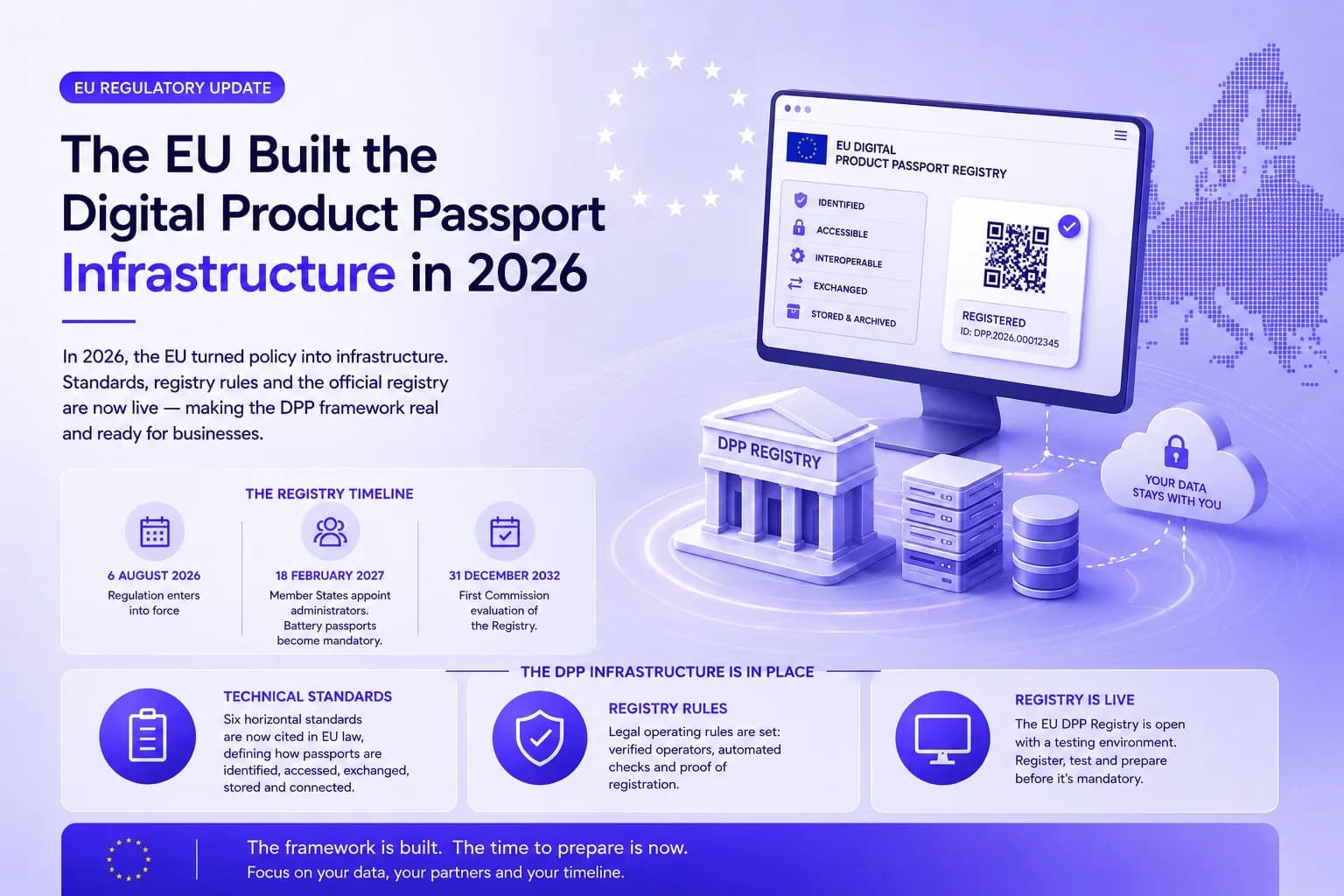
2026 was the year the European Commission stopped describing the Digital Product Passport and started building it. Three pieces of infrastructure landed in quick succession: the technical standards, the legal rules for the central registry, and the registry itself. Together they answer questions that were genuinely open twelve months ago. If your passport project has been waiting for the framework to settle before committing to an approach, the waiting is over.
The technical standards are now cited law
For most of the DPP's life, the technical questions were unresolved. How is a passport identified? How does a scanner reach it? How do two systems exchange passport data? How long must it be stored? Everyone building in this space made reasonable assumptions and hoped they matched what CEN-CENELEC would eventually publish.
That gap closed with Commission Implementing Decision (EU) 2026/1736, which cited the first six horizontal DPP standards in the Official Journal. The six are EN 18216, EN 18219, EN 18220, EN 18221, EN 18222 and EN 18223, and conformity with them now carries a formal presumption of conformity with the ESPR's passport requirements.
Between them, the six standards establish how a passport is:
- Identified
- Accessed through data carriers
- Exchanged between systems
- Stored and archived
- Kept interoperable
- Connected through lifecycle APIs
The practical consequence is a shift in what compliance means. Until now, the conversation was almost entirely about content: which data points does Annex XIII require, and do we hold them. That question has not gone away, but it is no longer the whole question. Compliance now also covers how that information is identified, structured, exchanged and managed across the product's life. A passport holding every required field but published outside the standards framework is not a compliant passport.
Two further standards, covering authentication and access rights management, are still to follow.
The registry has legal operating rules
Commission Implementing Regulation (EU) 2026/1778 was adopted on 16 July 2026, published in the Official Journal the following day, and entered into force on 6 August 2026. It sets out how the central Digital Product Passport Registry actually operates.
Three dates are worth recording:
| Date | What happens |
|---|---|
| 6 August 2026 | The Regulation enters into force |
| 18 February 2027 | Member States appoint their National Registry Administrators. The same day battery passports become mandatory |
| 31 December 2032 | First Commission evaluation of the Registry |
The regulation also settles a point that caused a lot of confusion. The registry is not a central database of your product data. Passport data stays with the economic operator or a party it delegates to. What the registry does is confirm that a passport exists and can be found. Every passport submitted receives a persistent registration identifier, so a product can be referenced consistently across its whole life, and the Commission runs an automated check on structure and completeness before issuing proof of registration.
Two details in the adopted text deserve attention from anyone planning their 2027 timeline. Registering a passport requires becoming a verified economic operator first, proven through eIDAS identity means and valid for up to three years. And the automated check the Commission runs on submission is explicitly not a proof of compliance.
A registered passport can also generate proof of registration at any time. That proof carries the unique product identifier, the verified identity of the responsible operator, a timestamp and a hash of the passport version, and stays available for 90 days once generated. It is the artefact an importer or authorised representative will realistically present when asked to show the obligation is met.
The registry is open
The EU Digital Product Passport Registry is now live, alongside a testing environment. Organisations can register, access the sandbox and download the User Guide for Economic Operators.
This is the part worth acting on rather than reading about. There is no advantage in discovering how registration behaves in February 2027. The testing environment exists precisely so that the procedural step is boring by the time it is compulsory.
The Commission has also launched a Digital Product Passport Guidance Hub, bringing together the framework overview, product groups in scope, FAQs, implementation news, webinars and supporting documentation in one place. Its FAQ is a genuinely useful primary source and confirms the direction of travel across categories.
What this means if you make batteries
Batteries are first in the queue, and that has an effect beyond the battery industry. Whatever architecture works or fails for batteries becomes the working model for textiles, iron and steel, construction products and everything else on the ESPR working plan.
For a battery manufacturer, the year's developments change the shape of the remaining work rather than its size. The regulation set the destination. The standards now set the route. What has not changed, and what still consumes most of the calendar, is assembling the data itself: carbon footprint per model per plant, material composition down through the supply chain, recycled content, and the lifecycle information that keeps updating after the battery is sold. That work is measured in months and depends on suppliers who have their own priorities.
Registration with the Commission, by contrast, is a short procedural step. The risk was never in the registry. It was always in the data behind the passport.
What comes next for construction
For construction products, the pathway runs through the revised Construction Products Regulation rather than the ESPR delegated acts. Product-specific requirements for harmonised building materials will be defined through delegated acts. Once the relevant rules and harmonised standards are in place, companies have an 18-month compliance window.
That window sounds generous. It is roughly the same preparation time battery manufacturers had, and the ones who started late are not finding it comfortable.
Primary sources
- Commission Implementing Decision (EU) 2026/1736 — citing the six harmonised standards
- Commission Implementing Regulation (EU) 2026/1778 — registry implementation arrangements
- European Commission DPP Guidance Hub
- EU Digital Product Passport Registry
- European Commission FAQ on the Digital Product Passport