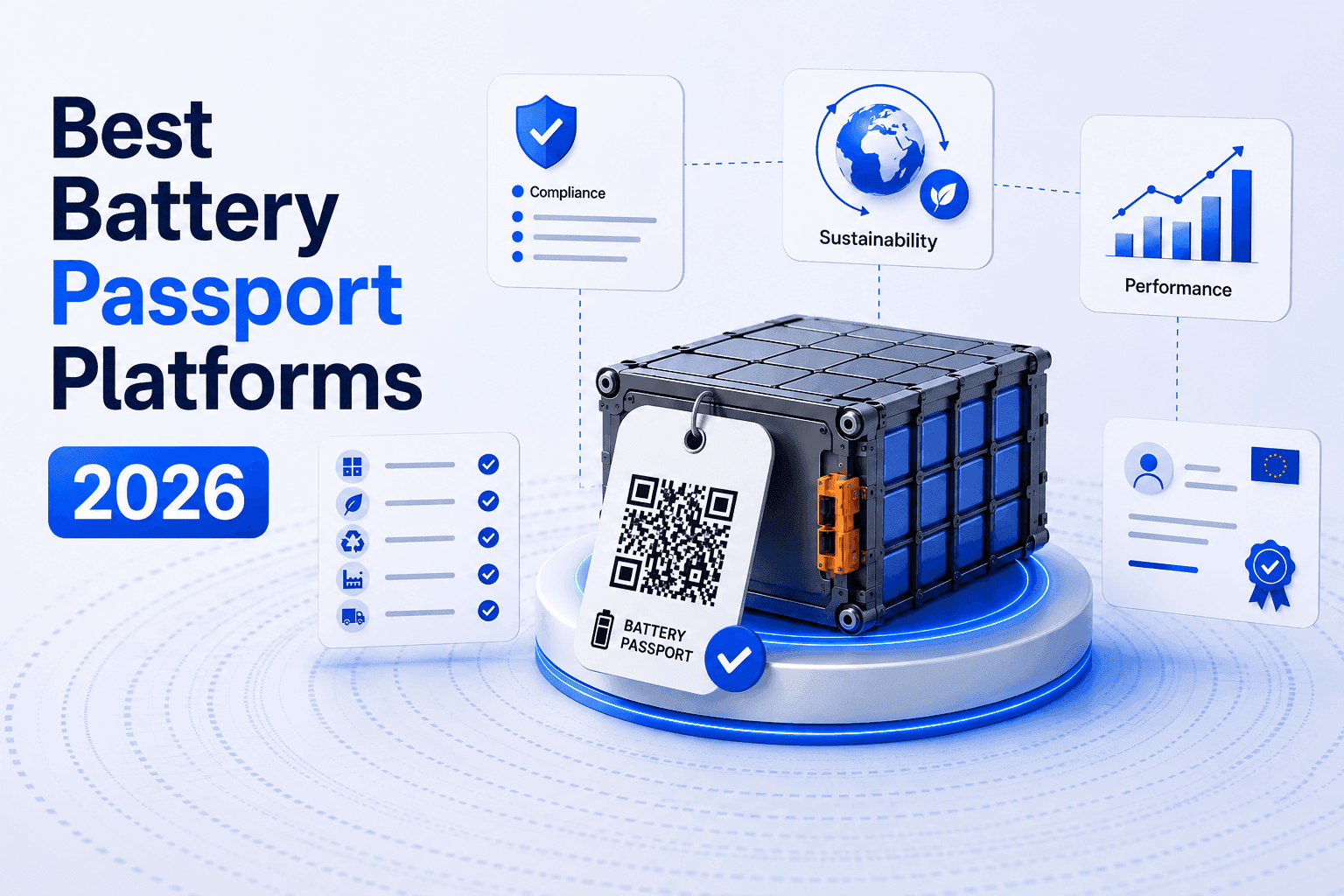
A battery passport is a digital record for one battery. It shows what the battery is, what it is made of, its carbon footprint, where its materials came from, and how it performs. You open it by scanning a code on the battery, usually a QR code. From 18 February 2027, most batteries sold in the EU must have one. Battery passport platforms help companies collect that data, check it, and publish it. This page compares nine European providers - Circuland, Circulor, Circularise, Spherity, Minespider, Narravero, osapiens, Siemens and T-Systems - on what they offer, what they publicly document, and who they suit.
Disclosure: Circuland wrote this comparison and is one of the platforms listed. Facts about the other vendors come from their own public websites, checked in August 2026, with links in each entry. Where a vendor does not answer a question publicly, we say "not documented" instead of guessing.
On this page:
Quick answer · What the regulation requires · How to compare platforms · Comparison at a glance · What each platform documents · The platforms · FAQ
Quick answer
There is no single best battery passport platform. The right choice depends on what you need most. If you want one platform that does the whole job with the least effort, and QR codes that stay under your own control,Circuland is a strong option. If tracking raw materials and material provenance is your main need, and you also want product‑level ESG and lifecycle data with on‑premise deployment as an option, Minespider is a strong fit. If you need end‑to‑end traceability with a large existing network of battery suppliers and critical‑mineral due‑diligence data, look at Circulor. For sharing battery passport and due‑diligence data with many suppliers under strict control, across Collect–Trace–Share workflows and governed disclosures, look at Circularise. For digitally signed, provable battery and product data, with VERA’s verifiable‑credential–based Digital Product Passports, EU Business Wallet integration and Catena‑X, look at, Spherity. For passports that double as customer-facing product pages, Narravero. For enterprises that want battery-passport data connected to broader product-compliance, supplier-data and sustainability workflows across several EU requirements, look at osapiens. And if you already work with Siemens or Deutsche Telekom, Siemens or T-Systems will fit that relationship.
What the regulation requires
From 18 February 2027, Article 77 of the EU Battery Regulation (EU) 2023/1542 requires a battery passport for:
- every EV battery
- every LMT battery (light means of transport, such as e-bikes and e-scooters)
- every industrial battery above 2 kWh
placed on the EU market.
Every battery gets its own passport. Anyone must be able to open it by scanning a code on the battery (usually a QR code). That code carries a unique identifier: a kind of serial number that also works as a web link. The data must be structured so both people and software can read it. Two European standards, published in 2026, set the technical rules: EN 18219 says what the identifier must look like (the two main options are GS1 Digital Link and IEC 61406), and EN 18220 sets the rules for the QR code that carries it.
How to compare battery passport platforms
The real question is not which platform has the most features. It is which one takes the least effort to run, without locking you in. Ask these questions.
Effort and fit
A. Does it cover the EU Battery Regulation (2023/1542)? The platform should support the regulation itself, not just store data in roughly the right shape.
B. Does it connect to the systems your product data already lives in? Most of the data you need already sits in company systems like ERP, PIM and PLM (the software where product, planning and design data lives). Good connections save months of copy-and-paste.
C. How much of the work is manual? The real cost is not the licence fee. It is the hours your team spends collecting, checking and updating passport data.
D. Can you get a passport live without an IT project? You should be able to enter data, create a passport, and share it with a QR code without a big rollout.
E. Can it handle several brands or business units, and custom domains? This matters if your company has more than one brand, site or legal entity, and if you want passports published on your own web address.
F. Does it support your languages? Buyers, recyclers and consumers across the EU will read these passports, not just your own team.
Lock-in and conformance
G. Which identifier type does the QR code use? EN 18219 allows a small set of types. GS1 Digital Link needs a GS1 membership (GS1 is the barcode organisation). IEC 61406 does not: you issue the identifier yourself. Many EV and industrial battery makers have no GS1 barcodes, so a platform that only supports GS1 (or only its own made-up links) limits your options.
H. Whose web domain is in the QR code, and what happens if you switch providers? Battery passports must stay available for years after the battery is sold. If the printed code points at the vendor's domain, your codes break (or are held hostage) when you leave. If it points at a domain you own, your codes keep working wherever you go. This is a compliance question, not just a buying question.
I. Is pricing public? Most vendors only give prices on request. Of the nine compared here, only Circuland, Minespider and T-Systems publish prices. A hidden price means a sales process before you can even compare.
Comparison at a glance
| Platform | Positioning | Best for |
|---|---|---|
| Circuland | Battery passport platform for EV, industrial and LMT batteries, DPP expertise, system integrations and multi-brand support | Companies that want one practical end-to-end platform: low effort, connections to existing systems, multi-brand in one account, custom domains, 28 languages |
| Circulor | Battery lifecycle transparency and traceability | Companies that need strong end‑to‑end battery traceability and due‑diligence proof on critical raw materials, especially in EV programmes and BESS projects |
| Circularise | Supply-chain traceability and governed data disclosure for Digital Product Passports | Organisations building battery passports across multi-tier supply networks that want to collect supplier evidence, connect material and battery records, and provide tailored public, partner, customer and regulator disclosures |
| Spherity | Cross‑industry DPP software and decentralised identity | Organisations that specifically need did:web and verifiable credentials (digitally signed data), EU Business Wallet integration, and DPPs built on decentralised identity for batteries and other regulated products |
| Minespider | Product identity, ESG and material provenance | Organisations focused on raw‑material provenance and responsible sourcing, or that need on‑premise deployment |
| Narravero | Customer- and partner-facing DPPs | Consumer brands that want the passport to double as a product page |
| osapiens | Product compliance, supplier intelligence and Digital Product Passports | Enterprises that want battery-passport data connected to broader product compliance, supplier evidence, sustainability data and adjacent EU requirements such as PPWR and REACH |
| Siemens | Industrial DPP and battery passport SaaS | Large industrial companies already using Siemens systems |
| T-Systems | Modular managed DPP | Large enterprises already working with T-Systems or Deutsche Telekom that prefer a managed service |
What each platform publicly documents
The table above tells you who each platform is for. The one below records what each vendor actually documents, on the questions from criteria G to I. "Not documented" means the vendor's own website does not answer the question, as of August 2026.
| Platform | Identifier type (documented) | Customer-owned QR domain | Codes survive vendor exit | Pricing public |
|---|---|---|---|---|
| Circuland | GS1 Digital Link + IEC 61406, per organisation | Yes (ownership verified, automatic certificates) | Yes | Yes (published, free tier) |
| Circulor | Not documented | Not documented | Not documented | No |
| Circularise | GS1 Digital Link (GTIN + serial) | Yes | Stated ("links remain valid") | No |
| Spherity | W3C DID + verifiable credentials | Not documented as a product feature | Not documented | No |
| Minespider | Not documented | Not documented | Not documented | Yes (from EUR 11,900/year) |
| Narravero | GS1 Digital Link | Not documented | Not documented | from €8,000 one time / from scope |
| osapiens | GS1 Digital Link | Not documented | Not documented | No |
| Siemens | Not documented (AAS / Catena-X models) | Not documented | Not documented | No (tiers XXS-XL) |
| T-Systems | Not documented | Not documented | Not documented | Yes (from EUR 1,499/month) |
The decoupling test: ask any vendor two questions before you print a single label. First: which EN 18219 identifier type does the QR code use? Second: if we leave in three years, do the codes already printed on our batteries keep working? A platform is only truly decoupled when the answer to the second question is yes, because the web domain is yours, not the vendor's. Every label printed against a vendor-owned domain locks you in deeper.
Battery passport platforms compared
1. Circuland
What Circuland offers: Circuland is a battery passport platform built for the EU Battery Regulation (2023/1542), covering EV, industrial and LMT batteries. The team has delivered Digital Product Passports in other industries too. The platform connects to the systems where your product data already lives (ERP, PIM, PLM) and brings data collection, passport creation, QR labels and compliance workflows into one place. Developers can connect other systems through its API, and a plugin marketplace offers Akeneo PIM, Pimcore PIM and Autodesk Revit connectors (in beta).
Identifiers and QR codes (built to EN 18219 and EN 18220):
- Works with or without GS1 membership: organisations that hold a GS1 GTIN (a barcode number) use GS1 Digital Link (with validation that catches invalid GTINs); everyone else gets a compliant, self-issued IEC 61406 identifier
- QR codes come print-ready and standards-compliant, with the identifier written out next to the code and clear guidance on printed size and quality (ISO/IEC 18004 symbol, 4-module quiet zone, millimetre sizing with vector output, IEC 61406 recognition frame, ISO/IEC 15415 print-quality guidance)
- Printable label sheets built in for production runs
Domain ownership and vendor exit:
- Passports can live on a web address you own (for example, https://passport.mydpp.co.uk/), so the QR codes printed on your batteries keep working even if you later change solution provider. This is live today
- Setup is a one-time domain-ownership check your IT team completes in minutes (a DNS TXT record); security certificates are issued and renewed automatically
Lifecycle and access:
- Covers the full life of a battery: passports can be repurposed or retired, with the history kept; a retired battery's passport stays public with a notice instead of disappearing (as Article 77 requires)
- Anyone who scans the QR code sees the public data: no registration, app or password
- Extra data tiers for regulators and approved partners, unlocked only by explicit grants; every change to a field is logged
- Machine-readable JSON export aligned with the Battery Pass consortium format
Languages and accessibility:
- 28 languages on the app and the public passport pages, including all 24 official EU languages
- Inclusive Experience mode: dyslexia-friendly font, larger text, high contrast, light and dark themes - for operators in the app and for consumers reading a passport
Deployment and pricing: Nothing to install: Circuland runs in the browser as a cloud service (hosted on Microsoft Azure). Pricing is published, including a free tier to start with permanent passports.
Best for: Companies that want one platform to do the whole battery passport job with the least effort - and want the QR codes printed on their batteries to stay under their own control.
See it live: view an example battery passport (public, no registration) or create a free account to mint your own.
2. Circulor
What Circulor offers: Circulor is a traceability company first. Its platform (PROVE by Circulor) tracks materials like cobalt, graphite, lithium and nickel step by step through the supply chain, and its battery passport is built on top of that. It delivered the widely reported Volvo EX90 battery passport. It states its passport is built to ESPR (the EU's wider eco-design rules) and CEN/CENELEC JTC 24 standards, and is certified for Catena-X (the automotive industry's shared data network). Named partners include Volvo Cars, Bureau Veritas and TUV Rheinland.
Best for: Companies where tracking raw materials and responsible sourcing is the main job, especially in EV, with the passport as the output of that tracking.
Not documented: which identifier type its QR codes use, whose domain they resolve on, custom-domain support, pricing, and what happens to passports when a contract ends.
Sources: Battery passport · Volvo EX90 announcement · PROVE overview
3. Circularise
What Circularise offers: What Circularise offers: Circularise is a supply-chain traceability and data-sharing platform with a battery-passport offering for EV, LMT and industrial batteries above 2 kWh. Its battery-passport workflow brings together supplier evidence collection, battery and material traceability, and controlled disclosure of product data. Teams can map passport-data requirements to suppliers, internal owners and source systems; connect identifiers, batch history, supplier evidence and sustainability claims in an auditable data record; and share tailored views through QR codes, APIs and partner access. Named customers and partners include Honda, Samsonite, Teijin and Mitsubishi Chemical Group.
Best for: Organisations that want a governed, multi-party battery-passport data foundation: supplier evidence collection, traceability, and controlled sharing for consumers, supply-chain partners, customers, auditors and regulators.
Sources: Battery passport · Share / identifiers · Pricing
4. Spherity
What Spherity offers: Spherity's software (VERA) covers several product types, including batteries. Its core idea is digitally signed data: passports are issued as verifiable credentials, so anyone can check who issued the data and that nobody changed it (its technology includes did:web). It targets the February 2027 battery deadline and integrates with industry data ecosystems (Catena-X, Gaia-X, IDTA). It has published joint work with GS1 Germany on combining GS1 Digital Link with verifiable credentials. Named work includes BVG Berlin's e-bus fleet.
Best for: Organisations that must be able to prove who issued the passport data and that it was not altered, or that specifically need did:web.
Not documented: whether customers can serve passports from their own domain as a product feature (demo passports resolve on subdomains of dpp.spherity.com), pricing, and exit terms.
Sources: DPP product page · Decentralised battery passport
5. Minespider
What Minespider offers: Minespider comes from mining and metals traceability, and its battery passport solution centres on product identity and material provenance. It offers several deployment options: cloud SaaS, on‑premise, and white‑label with your own branding. Catena‑X onboarding is offered as a service, with Minespider doing much of the technical heavy lifting for automotive SMEs that need to join the Catena‑X data space. Minespider holds ISO 27001, 9001, 14001 and 50001 certifications. Named collaborations and customers include Ford Otosan, Renault and Temsa. Pricing is published as three flat annual plans , €11,900 (up to 3 users), €19,700 (up to 10) and €34,500 (unlimited) , all with unlimited passports and battery models under fair‑use terms, and no per‑passport fees or free tier
Best for: Organisations focused on raw-material provenance and responsible sourcing, or that must run on-premise.
Not documented: which identifier type its QR codes use, whose domain they resolve on, and whether codes keep working after exit (on-premise gives you the data, but the platform itself is still vendor-updated).
Sources: Battery passports · Pricing · Open Battery Passport · On-premise
6. Narravero
What Narravero offers: Narravero builds passports that face the customer: product stories, role-based content and brand pages, alongside compliance. It is a GS1 Germany solution partner and uses GS1 Digital Link. It maps battery data to Annex XIII (the regulation's data list) in structured blocks with three access levels, and holds ISO 27001 and ISO 9001 certificates (security and quality management). Named battery work includes SEINE Batteriesysteme.
Best for: Consumer brands, especially in fashion and textiles, that want the passport to be both a compliance record and a customer channel - and that already have a GS1 relationship.
Not documented: whose domain the QR resolves on, custom-domain support, pricing, and exit terms.
Sources: Battery passport · Why Narravero
7. osapiens
What osapiens offers: osapiens offers Digital Product Passports within its wider Product Compliance Suite, which also covers product compliance, supplier data and sustainability workflows across EU requirements including PPWR, REACH, RoHS, PFAS, GPSR and SCIP. For batteries, it names LMT, EV and industrial battery categories, and documents GS1 Digital Link identifiers at product, batch or item level, connected to QR, NFC or RFID carriers. Its public material also describes ERP and PLM connections, supplier-data collection and role-based DPP access.
Best for: Organisations that want the battery passport as one part of a wider ESG and compliance setup, rather than a battery-focused specialist.
Not documented: whose domain the QR resolves on, custom-domain support, pricing, and exit terms.
Sources: DPP solution
8. Siemens
What Siemens offers: Siemens Battery Passport is a cloud (SaaS) product in Siemens Xcelerator. It creates, manages and exports passports, collects supplier data on sourcing, manufacturing, performance and environmental impact, offers a public REST API, and connects to Siemens engineering and manufacturing software (Teamcenter, MES). Its interoperability story is built on industrial data standards (AAS/IDTA) and Catena-X (through the Path.Era battery passport on Cofinity-X). Named proof-of-concept work includes BMW and Siemens Energy. Licence tiers exist but prices are not published.
Best for: Large industrial companies already using Siemens systems, or active in the Catena-X ecosystem.
Not documented: which identifier type its QR codes use, whose domain they resolve on, custom-domain support, and exit terms.
Sources: Battery passport · REST API
9. T-Systems
What T-Systems offers: T-Systems offers a managed Digital Product Passport service (Magenta DPP, on the Telekom Data Intelligence Hub). It covers the product lifecycle through to recycling, integrates manufacturing and usage data, and is strongly aligned with Catena-X (certified enablement service, Eclipse Dataspace Components, Gaia-X-compliant data spaces). It is one of three vendors in this comparison with published pricing (with Circuland and Minespider): Basic Compliance from EUR 1,499 net per month for up to 5,000 new battery passports per year. Named work includes DENSO's Catena-X EcoPass certification. Runs on any cloud or on-premises.
Best for: Large enterprises, especially Catena-X participants, that already work with T-Systems or Deutsche Telekom and prefer a managed service.
Not documented: which identifier type its QR codes use, whose domain they resolve on, custom-domain support, and exit terms.
Sources: Magenta DPP · DIH product page
FAQ (Frequently asked questions)
I. What is a battery passport?
A battery passport is a digital record for one specific battery. It covers the battery's identity, its maker, its materials, its carbon footprint, where its materials came from, and how it performs over time. You open it by scanning a code on the battery, usually a QR code. Some data is public. The rest is only for authorities, notified bodies and approved parties. It becomes mandatory in the EU on 18 February 2027 under Regulation (EU) 2023/1542.
II. What data must a battery passport contain?
Annex XIII of the regulation lists the content: who made the battery and what it is; the materials inside it (including critical raw materials and hazardous substances); its carbon footprint; supply chain due diligence; recycled content; performance and durability; and circularity information such as dismantling and safety instructions. Access is tiered: some data is public, some is only for authorities, notified bodies or parties with a legitimate interest.
III. Which battery passport platform is best?
There is no single best platform. It depends on your main need. Circuland is the strongest fit if you want one end-to-end platform with low effort, support for both identifier types (GS1 Digital Link and IEC 61406), and QR codes on your own domain. Circulor and Minespider lead on raw-material tracking. Circularise leads on controlled supplier data sharing. Spherity leads on digitally signed, provable data. Narravero leads on customer-facing passports. osapiens suits companies that want many ESG rules covered in one place. Siemens and T-Systems suit large enterprises already in their ecosystems.
IV. What must the QR code on a battery encode?
Under the 2026 CEN/CENELEC JTC 24 standards, the QR code (EN 18220) must carry a unique product identifier in one of the formats allowed by EN 18219, such as GS1 Digital Link or an IEC 61406 identification link. A QR code that only links to a vendor's web page with a made-up code does not meet the requirement. Of the platforms compared here, Circuland, Circularise, Narravero and osapiens publicly document GS1 Digital Link. Circuland also documents IEC 61406.
V. What if our company does not have a GTIN or GS1 membership?
GS1 Digital Link needs a GS1 membership and a registered company prefix, and many EV and industrial battery makers do not have one. The alternative allowed by EN 18219 is IEC 61406: an identifier you issue yourself, made globally unique by a web domain you control. Circuland is the only platform in this comparison that publicly documents both types, chosen per organisation.
VI. What happens to QR codes already printed on batteries if we change solution provider?
It depends on whose web domain is inside the QR code. If it is the vendor's domain, the codes break (or are held hostage) when you leave. If it is a domain you own, the codes keep working wherever you take them. Battery passports must stay available for years after a battery is sold, so this is a compliance question, not just a buying one. Circuland (customer-owned domains with automatic certificates) and Circularise (customer subdomains) are the only two platforms that publicly document customer-owned domains.
VII. Do any of these platforms fully comply with the JTC 24 EN standards?
Not yet, and no vendor honestly can. Two standards the others depend on (EN 18239 on access rights and EN 18246 on data authentication) are not published yet. What you can check today is the identifier and QR code layer. Circuland has implemented the EN 18219 identifier rules (both types, validated format, identifiers that work as web links) and the EN 18220 QR rules (ISO/IEC 18004 symbol, 4-module quiet zone, physical sizing, recognition frame, human-readable text). Circulor states its passport is built to JTC 24 standards but publishes no QR-level detail.
IX. Can consumers access the passport without an app or registration?
The regulation says public passport data must be open without registration. Check this per vendor. On Circuland, scanning the QR opens the passport in any browser with no account, app or password - see a live example battery passport.
X. Which vendor publishes pricing?
Three of the nine: Circuland (published pricing with a free tier), Minespider (from EUR 11,900 per year) and T-Systems (from EUR 1,499 net per month). The other six only give prices on request.
XI. Do retired or repurposed batteries keep their passport?
Yes, they should. Article 77 requires the passport to reflect status changes such as repurposing, and it must stay available after a battery is retired. On Circuland, a repurposed passport links back to its predecessor, and a retired passport stays public with a status notice.
See a battery passport in action
The fastest way to judge any of this is to open a real passport: open a live example battery passport in your browser. It is public, with no registration, app or password - exactly what the regulation requires. To build your own, create a free Circuland account.
About this page
Circuland maintains this comparison and re-checks it against vendor websites at each update. Corrections are welcome. If you represent a listed vendor and something is out of date, email contactus@circuland.co.uk and we will re-check and amend it with a dated note.