Ask a shipowner about the EU Battery Regulation and you will usually get a compliance answer: a date, a QR code, something for the technical department to sort out nearer the time. That framing is wrong, and the reason is arithmetic.
A hybrid ferry ordered today will not be delivered for two to three years. A retrofit programme scoped this autumn will put steel and batteries into vessels well into 2028. Practically nothing being contracted now arrives before 18 February 2027. The battery passport is therefore not a future compliance task. It is a term that belongs in contracts currently being negotiated.
What the regulation actually requires
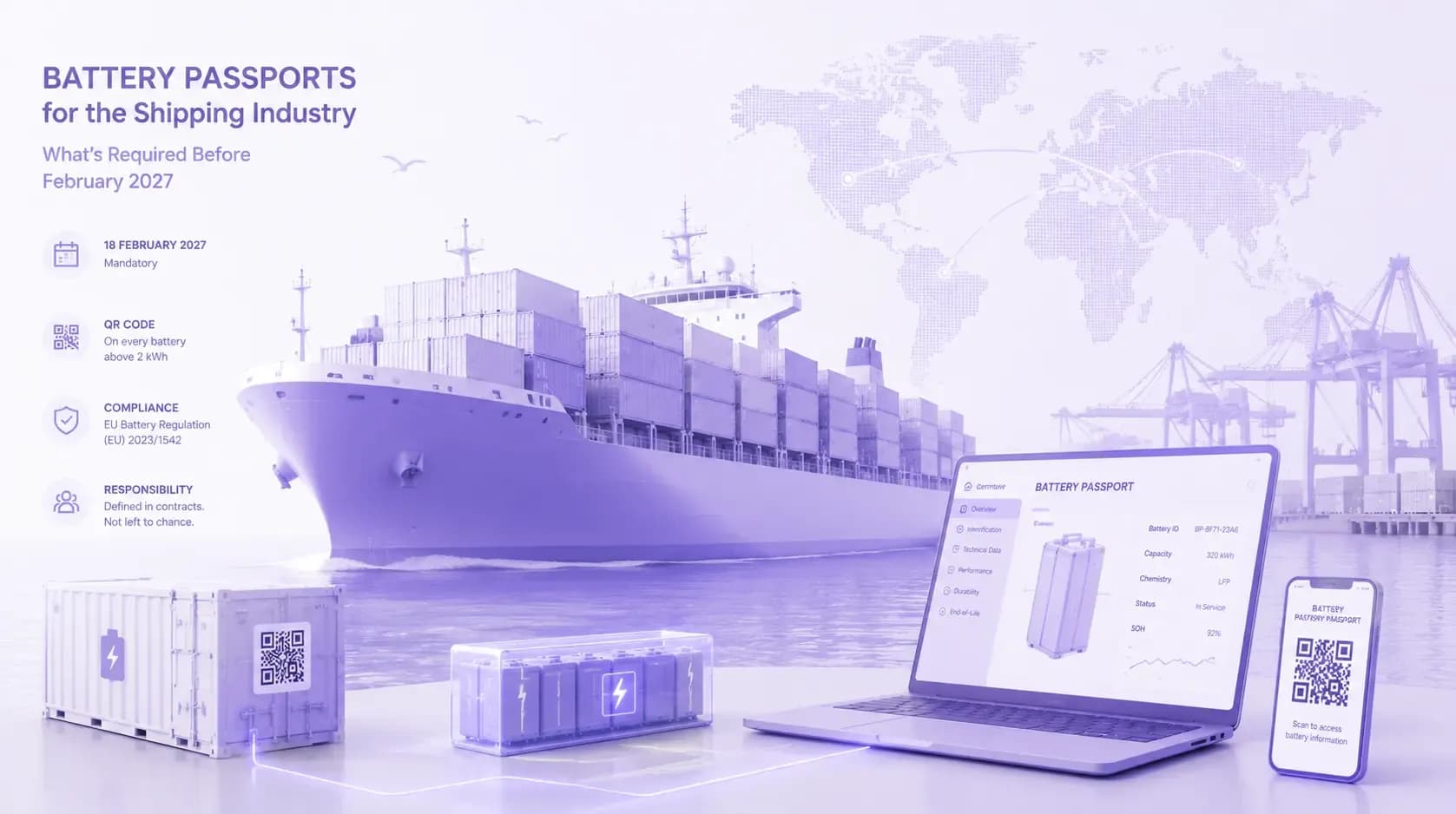
From 18 February 2027, every industrial battery with a capacity above 2 kWh placed on the EU market or put into service must carry an electronic record, a battery passport, accessible through a QR code on the battery itself.
That record holds identification and technical data, performance and durability parameters, and the information needed by anyone repairing, repurposing or recycling the battery later in life. Some of it is fixed at manufacture, and some of it changes as the battery ages. It is not a certificate issued once, it is a record that persists until the battery is recycled.
The 2 kWh threshold puts marine battery installations firmly in scope. Propulsion and hybrid systems on ferries, offshore support vessels, tugs, harbour craft and short‑sea vessels sit orders of magnitude above it. There is no maritime carve‑out and no tonnage‑based exemption.
In parallel, from the same 18 February 2027 date, all batteries, not only those with passports, must bear a QR code giving access to prescribed up‑to‑date information, including product identification, capacity, chemistry and end‑of‑life guidance.
For the underlying obligations and the full data requirements, see our EU Battery Passport Regulation Guide and the battery passport timeline. For maritime systems specifically, read our Maritime Battery Passport: EU Requirements for Vessels and Shore Power. For implementation at scale, explore Circuland’s Battery Passport platform.
The question shipping has to answer for itself
Most sectors applying this regulation deal with a straightforward chain, a manufacturer builds a product, an importer or distributor places it on the market, and the obligation attaches to one of them.
Shipbuilding does not work that way. Cells come from one manufacturer. A systems integrator assembles them into a marine‑certified installation. A yard installs that system into a hull. An owner, quite possibly established outside the EU and operating under a flag elsewhere again, takes delivery and puts the vessel into service.
Which of those parties placed the battery on the EU market? Each can point to another with a straight face. The regulation’s definitions fix responsibility on the economic operator who first places the battery on the market or puts it into service, but they do not resolve how a multi‑party marine project should allocate that role.
The industry has not resolved this. The Maritime Battery Forum’s working group has the definition of the responsible economic operator on its September agenda, which is itself an indication of how open the question remains. Until there is sector guidance, the reliable protection is contractual rather than regulatory, name the responsible party in the shipbuilding or supply agreement, require the obligation to flow through to the battery supplier, and make delivery of a compliant passport a condition of acceptance rather than a promise for afterwards.
For sector‑specific guidance, the Maritime Battery Forum’s Working Group on Battery Passports for Maritime Batteries is developing a practical approach and industry paper ahead of the 2027 deadline.
Two related questions sit beneath it. Whether the passport describes a module or a complete system, module‑level records are more precise and survive component replacement, while system‑level records carry far less administrative weight. And how continuously generated state‑of‑health data from a working vessel is recorded and updated without exposing utilisation and routing patterns an owner would reasonably treat as commercially confidential.
These questions are not unique to shipping. The same design decisions apply to grid‑scale storage and to industrial battery installations more broadly. Shipping simply has more parties in the chain and a longer asset life over which to get them wrong.
Four things worth doing before the end of the year
Map your delivery dates. Identify every newbuild and retrofit in the pipeline handing over after February 2027. Retrofits count, installing a battery system into a twenty‑year‑old hull is still placing a battery on the market, and the age of the vessel is irrelevant to the passport obligation.
Fix the contract template once. Retrofit and repowering programmes copy their specification from vessel to vessel. Correcting it on the first project is considerably cheaper than amending it across a fleet.
Specify capability rather than format. With the access rules still pending, oblige the supplier to deliver a passport meeting the requirements in force at delivery, to supply the underlying data in a structured, exportable form, and to update it at no cost if the rules shift before handover.
Ask what your supplier has built. Not what they intend to build. A battery supplier without a concrete answer six months out is a supply‑chain risk, not a compliance question.
Maritime battery passport FAQ (based on MBF working group discussions)
The answers in this section draw on meeting minutes from the Maritime Battery Forum’s working group on battery passports for maritime batteries, adapted for shipowners and yards.
Does the maritime industry expect an extension beyond February 2027?
No. The working group has explicitly chosen not to lobby for a deadline extension. The focus is on meeting the existing date with a practical, phased passport implementation rather than assuming extra time will be granted.
Will non‑EU‑flagged vessels need battery passports?
Legally, the obligation attaches when a battery is placed on the EU market or put into service in the Union. The working group recommends a global passport standard for maritime batteries, regardless of flag or home port, to avoid a loophole where non‑EU‑flagged vessels undercut compliant operators and to simplify manufacturing with a single passport model.
Is the passport at module level or system level for marine batteries?
The consensus emerging from the working group is a multi‑level approach. Static data such as origin, materials and compliance is tied to the module, because the module is the smallest replaceable unit. Dynamic data such as state of health and operating profile is managed at system level, where the battery management system actually calculates it, and then associated back to the relevant modules.
Who is the “economic operator” responsible for the passport over a vessel’s life?
Responsibility follows the economic operator who is placing the battery on the EU market at that point in its lifecycle. That will typically be the battery system manufacturer or importer at first placement, and then a different operator again if the battery is repurposed or sold into second life, who must issue a new passport linked to the original. In practice, contracts between yard, integrator and owner need to reflect this shifting responsibility.
How often does dynamic data, like state of health, need to be updated?
The working group recommends periodic and event‑driven updates instead of continuous streaming. Update frequency should be agreed commercially between the battery supplier and the operator, with status changes such as maintenance, replacement or repurposing triggering new entries, and histograms or summary statistics used to capture charge, temperature and throughput over time.
Is state of health tracking mandatory for maritime batteries?
Under the current framework maritime batteries are treated as industrial batteries, and state of health tracking is not strictly mandated. The working group nonetheless recommends recording state of health and related performance metrics as best practice, because they are critical for safety, maintenance planning and second‑life decisions.
What extra data will maritime passports need compared with other sectors?
The working group expects maritime‑specific approvals, such as class type approval and marine test reports, to be explicitly included in the passport, so buyers can distinguish batteries certified for marine use from those only tested to general industrial standards. It also highlights module‑level tracking of extreme temperature events, deep discharges and other stressors as important for repair and second‑life reuse.