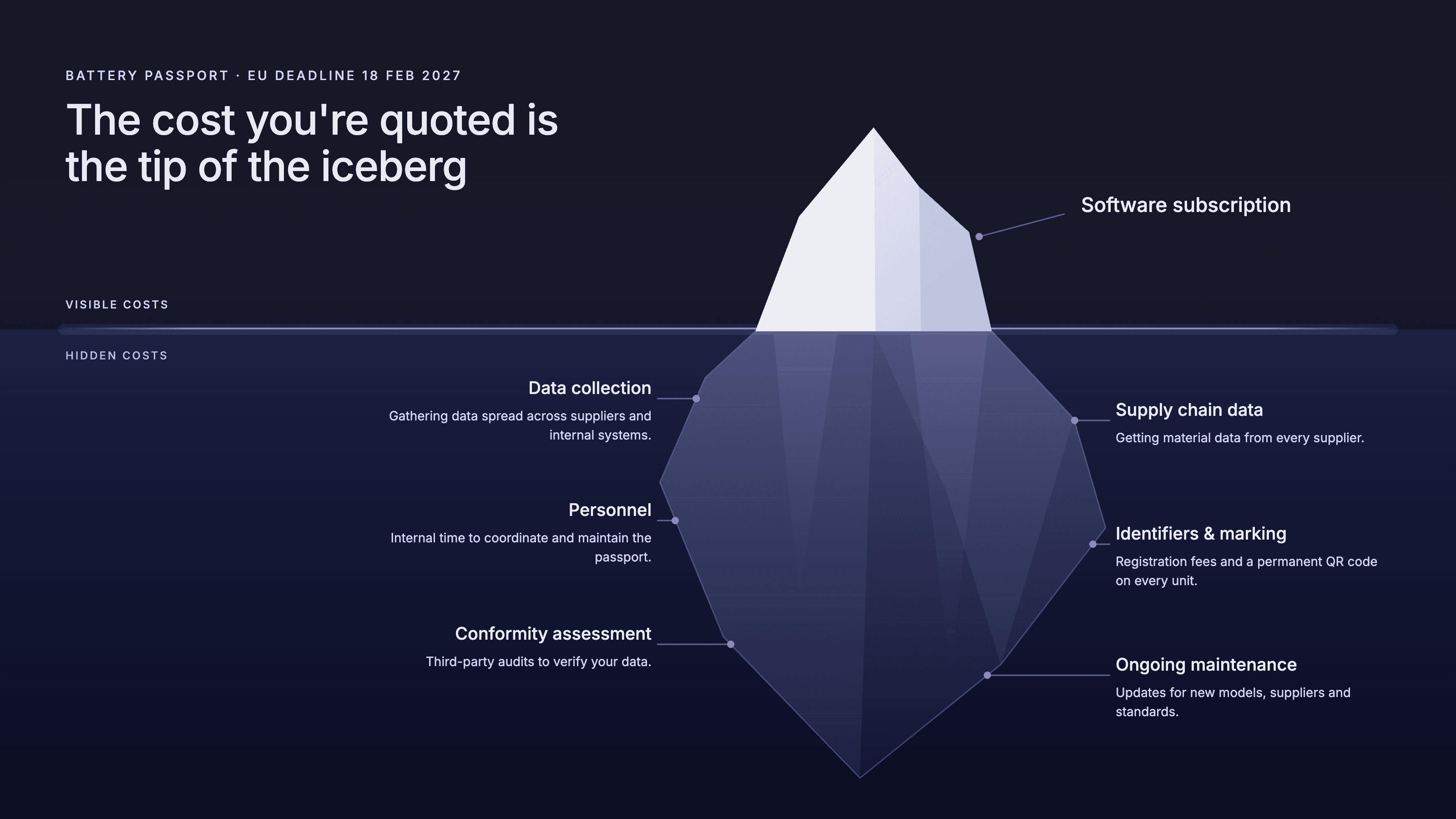
The number you're quoted is the visible part
A software price is real, and it's usually the smallest number in the whole exercise. Everything below it still has to get done, mostly by internal time rather than an invoice.
There is one visible cost: Software subscription. What the quote doesn't show:
| Phase | Hidden cost | What it covers |
|---|---|---|
| Phase 1 | Data collection | Chasing material composition and manufacturing data across every supplier, often for the first time. |
| Phase 1 | Identifiers and marking | GS1 registration fees and a physical QR code applied to every unit that leaves the factory. |
| Phase 2 | Conformity assessment | Notified body fees, where a battery category requires third-party sign-off before it can be placed on the market. |
| Phase 2 | Carbon footprint calculation | A life-cycle assessment per battery model, built in-house or bought in from a consultancy. |
| Phase 3 | Internal coordination | Someone has to own supplier follow-up, check the data and keep the passport moving toward publication. |
| Phase 3 | Ongoing maintenance | Updates whenever a battery is reconditioned, a supplier changes, or an implementing act adds a new field. |
The three phases where cost lands
Cost does not arrive as one invoice. It lands in three phases that overlap the compliance timeline itself, and each phase behaves differently: some of it is a one-time fee set by a third party, some is internal labour that scales with your product range, and some is an ongoing subscription.
Phase 1: Get the data and identifiers in place (Before anything can be generated)
Every battery model needs a unique identifier and a QR code before a passport can exist. The regulation requires an ISO/IEC 15459-series identifier, not a specific scheme, but most manufacturers get one through GS1 membership (a GLN or GTIN), with the fee set by the national GS1 organisation rather than by Circuland or the EU, and pricing varies by country and range size. That part is relatively small and predictable compared with other external fees.
The data behind it is not. Working out which of Annex XIII's data points apply to each model, then chasing cell suppliers, component makers and contract manufacturers for material composition, recycled content and manufacturing data, is mostly labour rather than a fee anyone invoices. It scales with the number of suppliers and models in a range, not with the size of the manufacturer.
Phase 2: Certify and declare (Runs alongside phase 1, finishes later)
Where a battery category needs third-party conformity assessment, engaging a notified body is typically the single largest external fee in the whole exercise, set by the notified body rather than Circuland or the EU. Notified body capacity is finite, and demand rises sharply as 18 February 2027 approaches, so the lead time matters as much as the cost.
Carbon footprint declaration has its own earlier deadline for some categories, and needs a life-cycle assessment against the Commission's methodology once finalised. The first calculation for a model is typically the expensive one; updating it for a later supplier change is typically far cheaper.
Phase 3: Publish and keep it current (Starts once the first passport goes live, then continues)
This is the only phase software pricing actually covers: hosting the record, managing public and restricted access tiers, and keeping it current as data changes. Built in-house, it is engineering time now and ongoing maintenance for as long as the regulation applies. Bought as software, it becomes a subscription.
It is also the phase that never really ends. A passport needs updating whenever a battery is reconditioned, a supplier changes, or an implementing act adds a new field, for as long as that model stays on the market.
Building in-house vs buying software
The identifier, conformity assessment and carbon footprint costs from phases 1 and 2 apply whichever route you take. What changes is phase 3: whether your own team spends months building and maintaining the software that turns your data into a compliant, QR-accessible passport, or you get that as a subscription from day one.
| Aspect | Building it yourself | Using CirculandRecommended |
|---|---|---|
| Setup time | Weeks to months of internal development | Days, using the product and supplier data you already have |
| Upfront cost | Engineering time, plus hosting and registry integration | No build cost, subscription only |
| Keeping up with implementing acts | Your team tracks and rebuilds against each update | Handled by our roadmap as guidance is finalised |
| Access tiers for restricted data | Built and maintained internally | Public and restricted tiers provided out of the box |
| Ongoing maintenance | Ongoing engineering resource | Included in the subscription |
What Circuland's platform costs
Circuland's own subscription pricing is the one figure in this whole exercise that Circuland actually sets. It is public, starts free for a handful of passports, and scales through Starter, Pro and Business plans as passport volume grows.
Full plan details, including annual pricing, are on the customer portal. It covers phase 3 above: hosting, access tiers and keeping the record current. It does not cover GS1 fees, notified body fees, or the internal time spent on data collection, since none of those are Circuland's to price.
The cost of getting it wrong
Regulation (EU) 2023/1542 does not set a fixed EU-wide fine. Article 93 requires member states to lay down their own penalties, which must be effective, proportionate and dissuasive, so the exact figure depends on where a battery is placed on the market. The costs that are consistent across every member state are these:
- A battery without a valid passport cannot lawfully be placed on the EU market or put into service, which can mean shipments held at customs or pulled from distribution.
- OEM customers increasingly require passport readiness as a supply contract condition, independent of the regulation itself, so non-compliance can mean lost business before a regulator ever gets involved.
- Remediation done under deadline pressure, after a shipment is already held up, generally costs more than the same work planned months in advance.
What you can work out yourself
Before asking a software provider or a notified body for a quote, a manufacturer can size most of the cost itself with information it already has:
- How many distinct battery models are placed on the EU market, since each one needs its own passport.
- How many of those models already have supplier data on file, versus how many need first-time supplier outreach.
- Whether the business already calculates carbon footprint anywhere, even informally, as a starting point for the formal declaration.
- How many units per model need physical marking, to estimate the QR code and labelling cost.
Battery passport cost FAQ
Is there a free plan for getting an EU battery passport?
Circuland offers a free plan covering a small number of passports, which is enough for manufacturers piloting the process on one or two battery models before committing to a paid plan.
What is usually the biggest cost driver?
For battery categories that require a notified body, conformity assessment fees are typically the largest single external cost. For categories that do not, data collection and supplier onboarding effort usually dominates instead.
Are there ongoing costs after the passport is published?
Yes. A passport needs updating whenever the underlying data changes, for example after a reconditioning event or a supplier change, and most manufacturers pay an ongoing software subscription to host and maintain the record.
Does this apply to small manufacturers too, or just large OEMs?
The obligation applies regardless of company size, wherever the battery itself is in scope. Cost scales with the number of battery models and suppliers involved, not with the size of the manufacturer.
Is the fine for non-compliance set at EU level?
No. Regulation (EU) 2023/1542 requires each member state to set its own penalty regime under Article 93, rather than fixing a single EU-wide figure.
A note on figures in this guide
Only Circuland's own subscription pricing is set by Circuland. GS1 identifier fees, notified body fees and member state penalty regimes are all set by third parties or national authorities, vary by market, and are not quoted here for that reason. For an article-by-article breakdown of where these obligations come from, see our EU Battery Regulation 2023/1542 explained, and for every deadline that forces this spending into a particular order, our EU battery passport timeline.