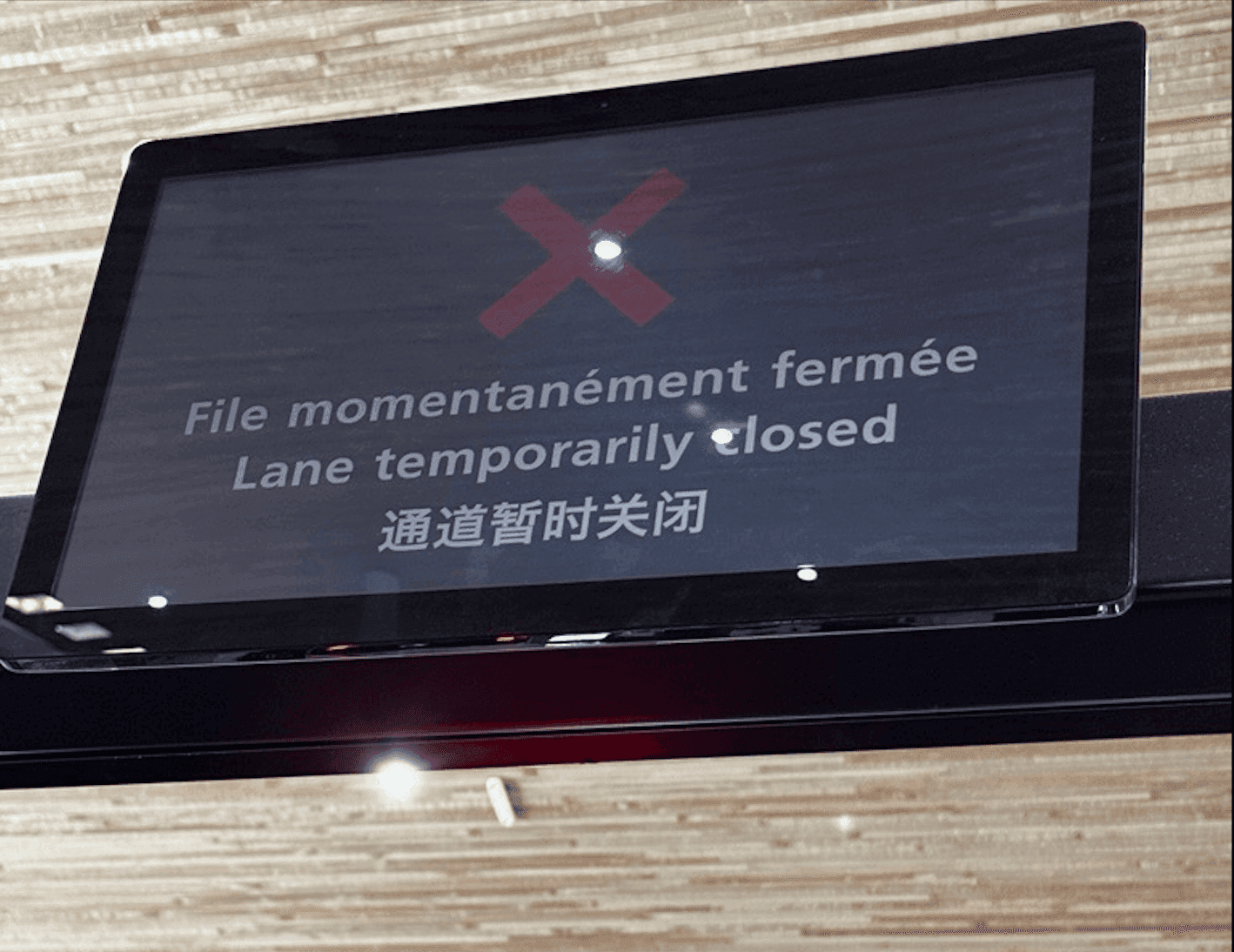
Last week at Charles de Gaulle (CDG) I watched the EU's new Entry/Exit System struggle in real time.
Lanes going red. My passport refusing to scan at the kiosk, then working instantly when an assistant did it by hand. Every single booth had a human assistant attached to it. The whole point of an automated eGate is throughput. If you need a person standing at each one to make it work, you have not automated the border. You have just added a touchscreen to a manual process.
Eight years of preparation, a difficult rollout
This is the Entry/Exit System (EES), introduced under Regulation (EU) 2017/2226. The policy intent is sound. Better data on overstays, stronger Schengen integrity, a digital record replacing inconsistent manual stamping. The challenge was never the law. It was the operational lift of getting it live across 29 countries simultaneously.
Adopted in November 2017, the full rollout finally happened on 10 April 2026. Even with eight years between adoption and launch, the operational realities have been tough.
The disruption is not trivial:
- Lisbon suspended its EES kiosks after queues hit seven hours
- Brussels, Greece and parts of Italy quietly reverted to manual passport stamping
- One flight to the UK reportedly departed with 51 passengers still stuck in screening
- ACI Europe, A4E and IATA have publicly called the rollout a "systemic failure" and warned of four hour queues over peak summer
The diagnosis is straightforward. Chronic understaffing. Unresolved kiosk and software issues. Very low uptake of the pre-registration app. And the fact that every non-EU traveller is a first-time enrolment requiring the maximum processing time. The automation does not remove the human from the loop, it just shifts what the human does.
Annoying for travellers. Some missed flights. Painful but recoverable.
But here is what made me sit down and write this.
February 2027 is nine months away
Under the EU Batteries Regulation (Regulation (EU) 2023/1542), Article 77, from 18 February 2027 three battery categories cannot be placed on the EU market or put into service without a Digital Battery Passport:
- Electric vehicle batteries: every EV battery sold in the EU
- Industrial batteries above 2 kWh: forklifts, manufacturing equipment, robotics, automated warehouses, grid scale storage, commercial energy systems
- Light means of transport batteries: e-bikes, e-scooters, e-mopeds
The passport must carry verified information on chemical composition, carbon footprint, recycled content, performance, durability, due diligence on raw materials, and end of life handling. Access is via a QR code on the battery itself. Different data layers are visible to the public, regulators, and recyclers and repurposers.
This is genuinely important policy. Better visibility into battery sustainability, safer materials, a real circular economy for some of the most resource-intensive products we make. The objective is one the industry should be behind. Making it work in practice is the hard part.
The legal position is unambiguous. No passport, no market access.
What "EES-style rollout" would actually mean
If this lands the way EES did, the consequences are not 100 missed flights.
They are EV manufacturers unable to ship into 27 markets simultaneously. Grid scale storage projects stalled at the border because the industrial battery units they ordered cannot legally enter the bloc. Hospitals, data centres and factories unable to source the industrial backup batteries they critically depend on for continuity. E-bike importers locked out of one of the largest cycling markets on earth. Existing inventory at distributors becoming inert paperwork the moment it crosses a docking bay without a compliant passport.
Unlike a missed flight, you cannot rebook a 40 foot container of batteries onto the next departure.
The pattern to learn from
Major regulations don't succeed or fail on the strength of the law alone. They succeed or fail on the strength of the ecosystem that has to make them work on go-live day.
EES had eight years of warning. The technology existed. The standards existed. The infrastructure existed. The rollout still hit serious operational issues, because the work of getting every airport, every kiosk, every border officer and every traveller actually ready was harder than the work of writing the regulation. That isn't a critique of the policy. It's the reality of complex implementation at scale, and it applies to any ambitious system regardless of who designs it.
Battery passports are not a UI on a kiosk. They are data flowing through long, fragmented, often opaque supply chains. From raw material extraction through to cell manufacture, pack assembly, OEM integration, and finally end of life. Every actor in that chain needs to be able to contribute and verify data. Every dataset needs to be queryable, attributable and tamper evident.
Making this work is a shared responsibility. Regulators have set the destination. Manufacturers, importers, suppliers and infrastructure providers have to build the road to get there. The companies treating this as a Q4 2026 problem are not preparing. They are gambling.
You have 9 months. Plan accordingly.
At Circuland we are building the infrastructure to make Digital Product Passports practical, compliant and easy across industries, including batteries. If you are responsible for getting your organisation ready for 18 February 2027 and want to talk through what good looks like, what your data gaps are, or where to start, I am happy to have a conversation.