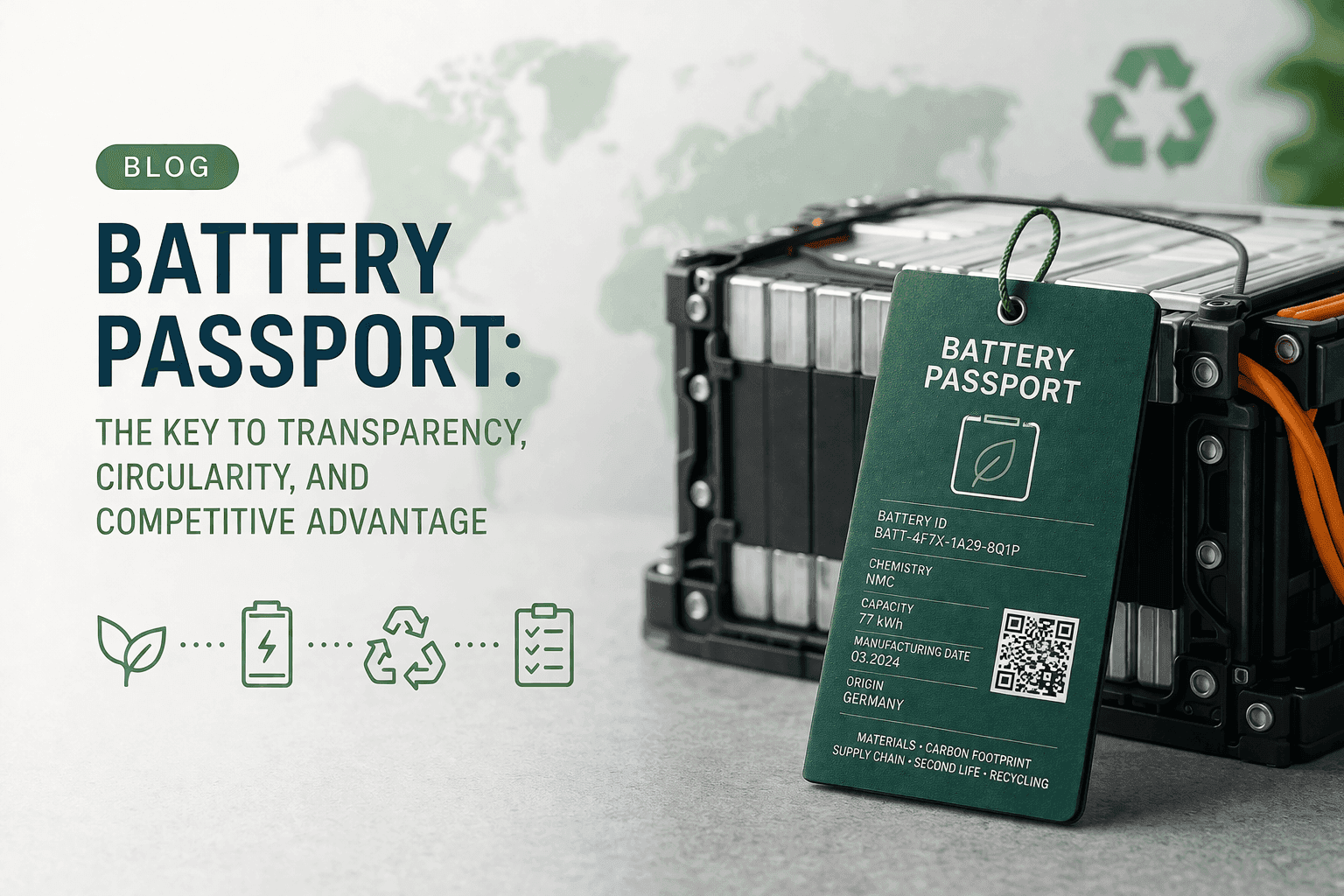
As of April 2026, the deadline for the EU Battery Passport is less than a year away. For any manufacturer, importer, or distributor placing industrial or electric vehicle (EV) batteries on the European market, the time for strategic planning is over; the time for implementation is now. Regulation (EU) 2023/1542 is not just another compliance hurdle,it's a foundational shift towards a transparent, sustainable, and circular battery value chain.
The demand for batteries is surging. The EU anticipates needing up to 18 times more lithium and 5 times more cobalt in 2030 compared to 2018 levels. To manage this explosive growth sustainably, the regulation mandates a Digital Product Passport (DPP) for each battery, creating a detailed digital record from raw material extraction to end-of-life recycling.
This guide provides a clear, actionable roadmap for manufacturers to navigate the requirements and meet the fast-approaching February 2027 deadline.
Who Needs to Comply?
According to the regulation, a Battery Passport is required for specific battery categories placed on the EU market, irrespective of their country of origin. The legal responsibility falls on the "economic operator" who first places the battery on the market.
Your organisation must comply if you manufacture, import, or distribute:
Industrial batteries with a capacity greater than 2 kWh.
Electric vehicle (EV) batteries.
Light means of transport (LMT) batteries (e.g., for e-bikes and e-scooters).
This mandate necessitates data collaboration across the entire value chain, from mining companies and cell producers to automotive brands and recycling facilities.
Key Compliance Deadlines Your Team Must Hit
Meeting the 2027 deadline requires understanding a series of phased requirements. While the passport itself is the main event, other crucial dates have already passed or are rapidly approaching.
18 February 2025: Carbon Footprint Declaration Manufacturers were required to calculate and declare the carbon footprint for each battery model per manufacturing plant. This declaration must be third-party verified and made publicly accessible online. This data will become a core component of the 2027 passport.
18 February 2027: Mandatory Battery Passports This is the critical deadline. All EV, LMT, and industrial batteries (>2 kWh) placed on the market from this date must have a unique, QR-code-accessible Battery Passport.
18 August 2027: Supply Chain Due Diligence Economic operators must have established and verifiable due diligence policies to address social and environmental risks in their raw material supply chains (e.g., cobalt, lithium, natural graphite).
What Data Must the Battery Passport Contain?
The Battery Passport functions as a secure digital ledger, with different information accessible to different parties. Each physical battery must be marked with a QR code that links to its unique passport. Data requirements, detailed in Annex XIII of the regulation, are structured to ensure both transparency for consumers and the protection of commercially sensitive information for businesses.
Information for the General Public
End-users and consumers will see general data to inform their purchasing and recycling decisions:
Manufacturer details
Battery type and model
Date of manufacture and placing on the market
Material composition, including critical raw materials
Carbon footprint summary
Information on responsible sourcing and recycled content
Information for Notified Bodies and Market Surveillance
Regulatory authorities will have access to detailed compliance data to verify conformity with EU law:
In-depth technical documentation proving performance and durability claims
Third-party conformity assessment reports
Detailed test results and manufacturing data
Information for Economic Operators
Authorised businesses involved in repair, remanufacturing, and recycling will see data essential for circular economy activities:
Real-time State of Health (SOH) and State of Charge (SOC) data
Detailed disassembly procedures and safety instructions
Technical information on replacement parts
Component and material data needed for high-efficiency recycling
A 5-Step Compliance Plan for Manufacturers
With the deadline looming, manufacturers must move decisively from planning to implementation. Following a structured checklist can mitigate risks and prevent last-minute crises.
1. Map Your Data and Identify Gaps
First, conduct a comprehensive audit of your internal data landscape. Identify what information you already collect in your Product Lifecycle Management (PLM), Enterprise Resource Planning (ERP), or Building Information Modeling (BIM) systems. More importantly, identify the data you don't have. What information on raw material origin, carbon footprint, or chemical composition do you need from upstream suppliers to fulfill the passport requirements? This audit is the non-negotiable foundation of your compliance strategy.
2. Engage Your Supply Chain Immediately
Gathering structured, verifiable data from a multi-tiered supply chain is the single greatest challenge in implementing a Battery Passport. You cannot do this alone. Start discussions with your Tier 1, 2, and 3 suppliers now. The risk of waiting is that you may find your suppliers are unwilling or unable to provide the necessary data, forcing you into a costly and time-consuming process of re-sourcing critical components. Establish clear data requirements, define secure sharing protocols, and confirm they can provide information in a machine-readable format.
3. Choose Your Technology Partner
Managing a continuous flow of data from dozens of global suppliers is impossible with spreadsheets and email. The risk of data errors, security breaches, and compliance failures is simply too high. You need a dedicated digital platform designed for this purpose. When comparing tools to manage battery passport data supply chains, look for a solution that offers more than just data storage.
Platforms like the AI-powered solution from Circuland are designed specifically for the complexities of DPPs. An effective platform acts as a central hub, integrating with your existing systems (PIM, PLM) to automate data collection, use AI to verify information, and manage granular access permissions securely. This is a critical piece of infrastructure for any serious battery passport solution for EV manufacturers in Europe, protecting you from data silos and ensuring interoperability.
4. Design Your Identifier and Labelling Process
Every battery requires a unique identifier, physically marked via a QR code. This is the gateway to the digital passport. Don't treat this as a minor detail; it's a manufacturing process change. Your strategy must ensure this identifier is permanently affixed to the battery and correctly linked to the digital record throughout its lifecycle, including repair and remanufacturing.
5. Run a Pilot Project
Before a full-scale rollout ,run a pilot program with a single product line and a few trusted suppliers This allows you to test your data collection processes, platform integration, and QR code generation in a controlled environment. A pilot will reveal unforeseen bottlenecks—such as supplier data formats or internal process flaws,and allow you to refine your approach before the 2027 mandate takes full effect, significantly de-risking your entire program.
The Risks of Delay vs. The Rewards of Early Action
Procrastination is not a viable strategy. Failing to comply with the EU Battery Regulation carries severe penalties. Market surveillance authorities can prohibit the sale of non-compliant batteries and order costly, brand-damaging product recalls. Beyond the direct financial impact, the reputational damage can erode consumer trust and market position for years.
However, proactive compliance unlocks significant competitive advantages:
Guaranteed Market Access: A compliant Battery Passport is your non-negotiable ticket to sell in the entire EU market.
Improved Product Performance: Data on durability and performance will drive innovation, leading to higher-quality products and stronger brand differentiation.
New Revenue Streams: Monetise lifecycle data by offering value-added services like extended warranties, battery health monitoring, or performance analytics.
Enhanced Brand Value: Demonstrating radical transparency and sustainability resonates with environmentally conscious consumers, investors, and business partners.
Conclusion: The Clock Is Ticking
The EU Battery Passport is no longer a distant concept; it is an immediate business imperative. The transition requires a coordinated effort involving data audits, deep supplier collaboration, and strategic technology adoption.
Manufacturers who view this as a mere box-ticking exercise will face significant operational and financial risks. Those who see it as a strategic opportunity to build more resilient, transparent, and circular supply chains will not only ensure compliance but also secure a powerful competitive advantage in the new green economy. The time to finalise your strategy and implement a robust digital product passport platform is now. The 2027 deadline waits for no one.